**IMPORTANT PARK NOTICES**
⚠️ Always monitor weather reports and ocean conditions before your park visit.
•
[KAUA’I] 6/19/26
The Puu Hina Hina Parking Lot will be closed on Monday June 22 for parking lot striping.
•
[O’AHU] UPDATED 6/18/26
There will be an early closure at 5PM HST on Saturday July 4, 2026 for Puʻu ʻUalakaʻa State Wayside (ʻUalakaʻa Trail) due to \\\"Fireworks Prohibited in the State Parks\\\"
•
[HAWAI’I] UPDATE 6/17/26
There will be an early closure at 5PM HST on Saturday July 4, 2026 for the West Hawaii State Parks (Kekaha Kai (Manini Owali & Mahai’ula), Kiholo, Hapuna SRA (Hapuna & Waialea) due to \\\"Fireworks Prohibited in the State Parks\\\"
•
[KAUA’I] UPDATED 5/27/26
Kalalau Trail from mile marker 2-11 after Hanakapiai Valley, will be CLOSED for a feral animal control hunt from June 1-4. The 2 miles of the trail from Keʻe beach at Haʻena State Park to Hanakapiai falls will remain open during this time.
—
Puʻu Hinahina parking lot will be CLOSED for road work from May 25-29 and again from June 15-19.
—
Koke’e State Park camping will be CLOSED for campground improvements. Construction to begin May 2026 and extend through Spring 2027.
—
Pāʻulaʻula State Historic Site: CLOSED for construction.
•
[O’AHU] UPDATED 6/10/26
Heʻeia State Park partial parking lot road closure due to landslide and upcoming stabilization work.
—
Wahiawā Freshwater State Recreation Area: Portions of the park which access the reservoir (Also known as Lake Wilson) will be closed Sunday, May 3, 2026 at 1 a.m. the park will remain open to visitors for onshore activities, but lake access via the boat ramp, reservoir banks, and reservoir shores will not be allowed until further notice.
—
Ka’ena Point State Park, Mākua Section has REOPENED to beach access. The Keawa’ula section remains CLOSED due to road repairs and damage due to the recent Kona Low storms. The Mokule’ia vehicle access road has REOPENED to valid permit holders - note some roads previously accessible have been closed due to storm damage - heed all road signs.
•
[MAUI] UPDATE 4/20/26
‘Iao Valley State Monument: Will be CLOSED until June 26, 2026 for safety improvements.
–
Polipoli Spring State Recreation Area: Polipoli cabins and camping areas are CLOSED until further notice.
•
[MOLOKAʻI] UPDATE 4/20/26
Pālāʻau State Park: Pālāʻau Wayside Pavilion and Campgrounds remain CLOSED until further notice.
•
[HAWAI’I] UPDATED 4/10/26
Notice to bidders for Mobile Food Truck Concessions opened today for certain Hawai’i Island parks. More information at: https://dlnr.hawaii.gov/dsp/announcements/mobile-food-truck-concessions-hawaii/
—
Akaka Falls State Park: Water and comfort station CLOSED, park open with portable toilets.
Sea Turtles
Posted on Oct 23, 2014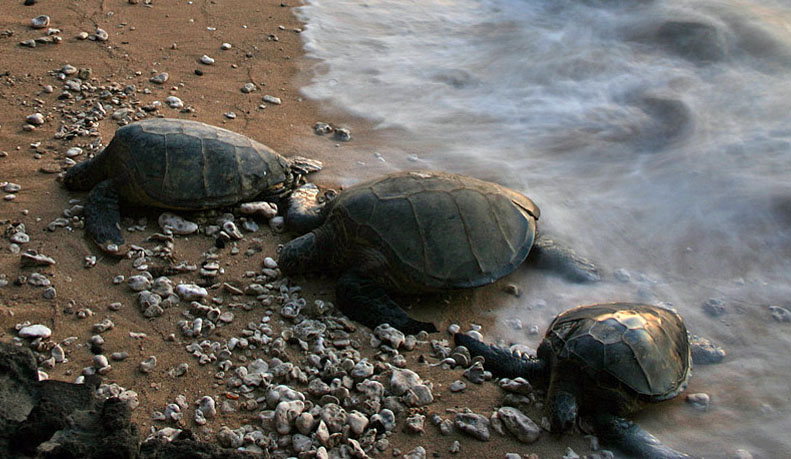
Green Sea Turtles resting on remote beach
Hawaiʻi hosts several species of sea turtles, but by far the most commonly seen is the Green Sea Turtle (honu). These large, gentle marine reptiles, typically 2-3 feet in shell length, frequent calm bays and shallow offshore reefs and lava shelves in Hawaiʻi where they feed on seaweed (limu). These turtles (which are actually dark brown in color) do come ashore regularly to bask and lay their eggs, although very few nest in the main islands. Most Hawaiian Green Sea Turtles migrate 800 miles north to mate and nest in the Northwest Hawaiian Islands on the sandy shores of French Frigate Shoals.
In the main islands , Green Sea Turtles are rarely seen in large numbers. They prefer isolated, uncrowded beaches, so they are difficult to view reliably. There are significant populations along Kauaʻi’s Nāpali Coast State Wilderness Park, where they can also be viewed via coastal boat tours. There are also viewing opportunities within parks along the Big Island’s Kona Coast. From shore they are most easily recognized when they surface to breathe, but can also be seen feeding on the shallow sea bottom. If you are in a vessel or swimming, diving or snorkeling and encounter a swimming turtle, give them a wide berth so as not to disturb them.
Hawaiʻi’s sea turtles are protected species’, and persons are strongly advised to maintain adequate distance (minimum 50 yards/45 meters) so as not to disturb them. Though they spend most of their time in the water, they frequently haul out to rest or ride out storms and this is normal behavior. Approaching a resting turtle may cause it to re-enter the ocean and compromise its safety. For more info, visit https://dlnr.hawaii.gov/dar/species/sea-turtles/