Hawaiʻi Island Talk Story Feedback
Hawaiʻi Island Talk Story Feedback
The Hawaiʻi Island Talk Story sessions hosted in the summer of 2026 were important for gathering community input on management priorities, proposed solutions, and the creation and organization of the island Navigation Team(s). A series of facilitated activities and discussions took place during these meetings, which included using paper handouts and interactive posters to help solicit feedback. Scroll through below to see the summary of input received during the Talk Story sessions!
Appreciative Inquiry
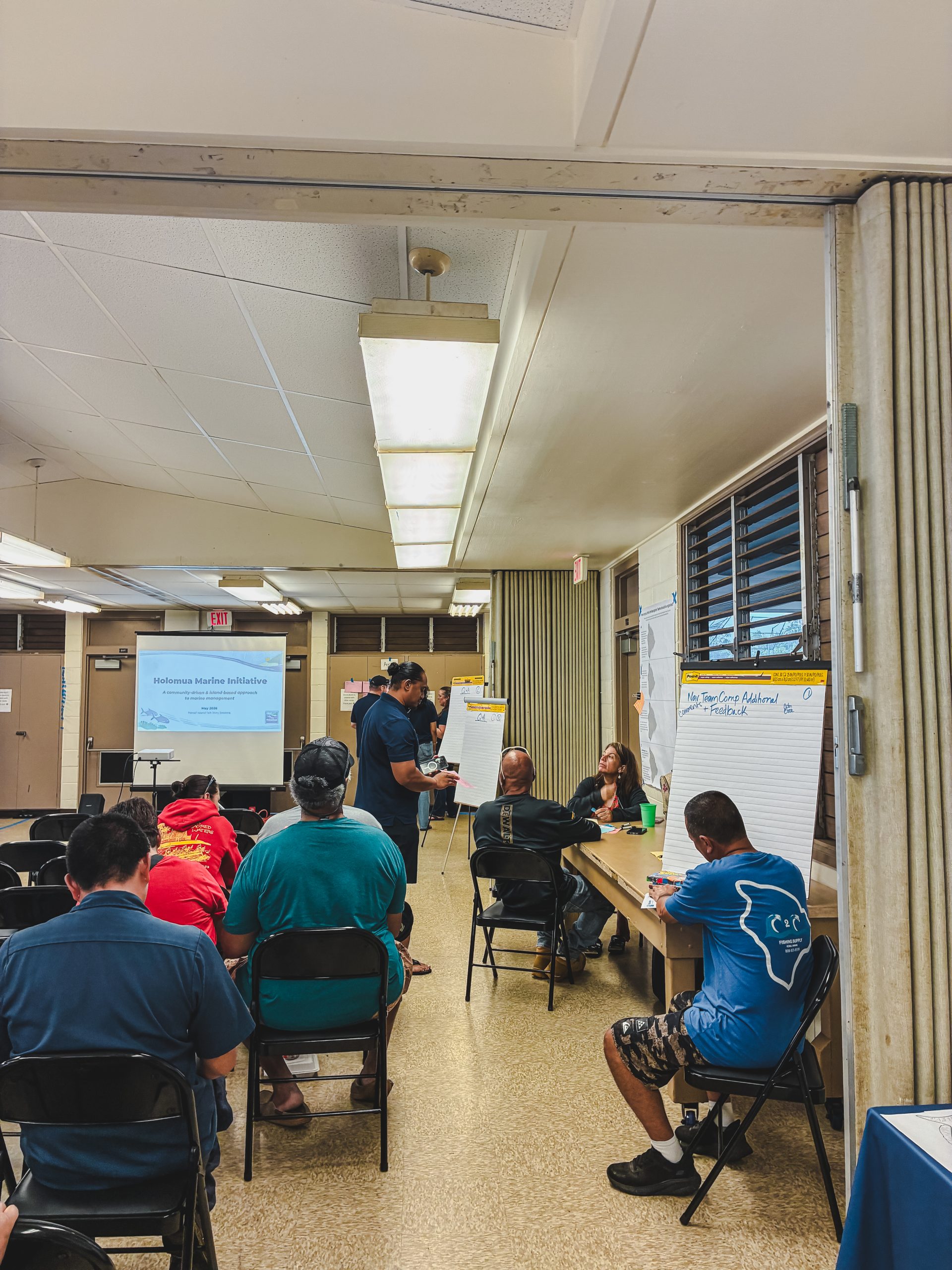
An activity called “Appreciative Inquiry” was facilitated at each of the Talk Story sessions, which is a method focusing on identifying “positives” and strengths first before co-creating solutions to achieve common goals. Paper slips were handed out to attendees when they arrived, and they were asked to fill out responses to the following three questions:
Question 1: In one or two sentences, share one example of the best experience you have had with aquatic resources (e.g. fishing, harvesting limu, coral reefs, ‘o‘opu, etc.) of Hawai‘i Island.
Question 2: In one or two sentences, what is the most significant challenge preventing you from having this experience all the time?
Question 3: What change could be made to address the challenge you identified?
The purpose of this activity was to build a shared vision for Hawai‘i Island’s nearshore resources and identify challenges and potential solutions to achieve that shared vision.
The Holomua Team is currently reviewing all of the responses shared during this activity and will post a summary on this page soon that will also be shared with the future Hawaiʻi Island Navigation Team(s).
Building the Navigation Team
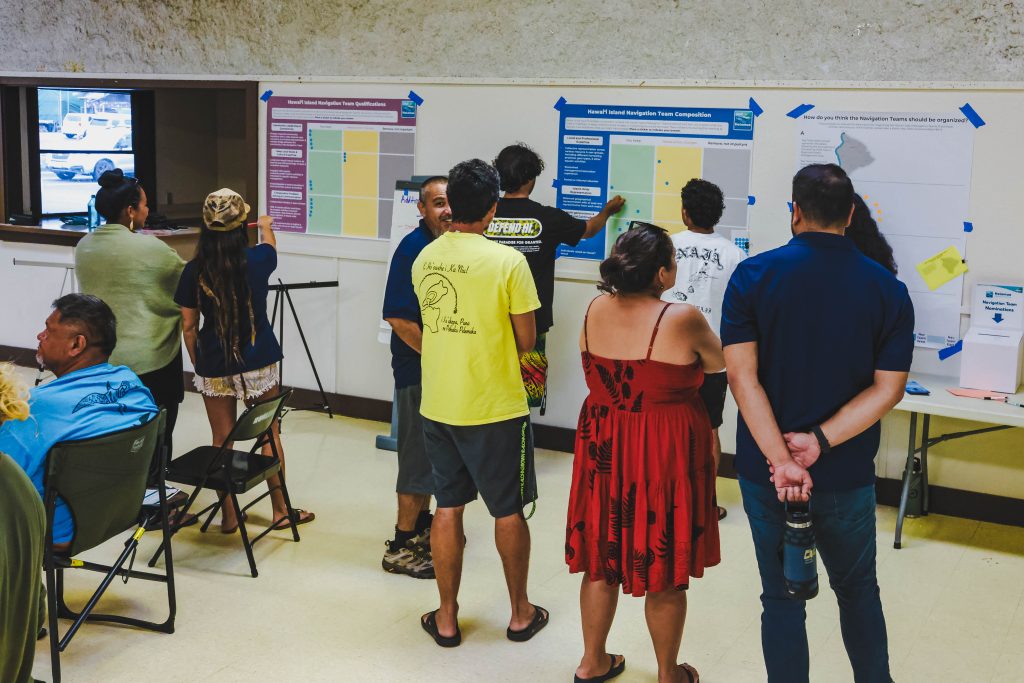
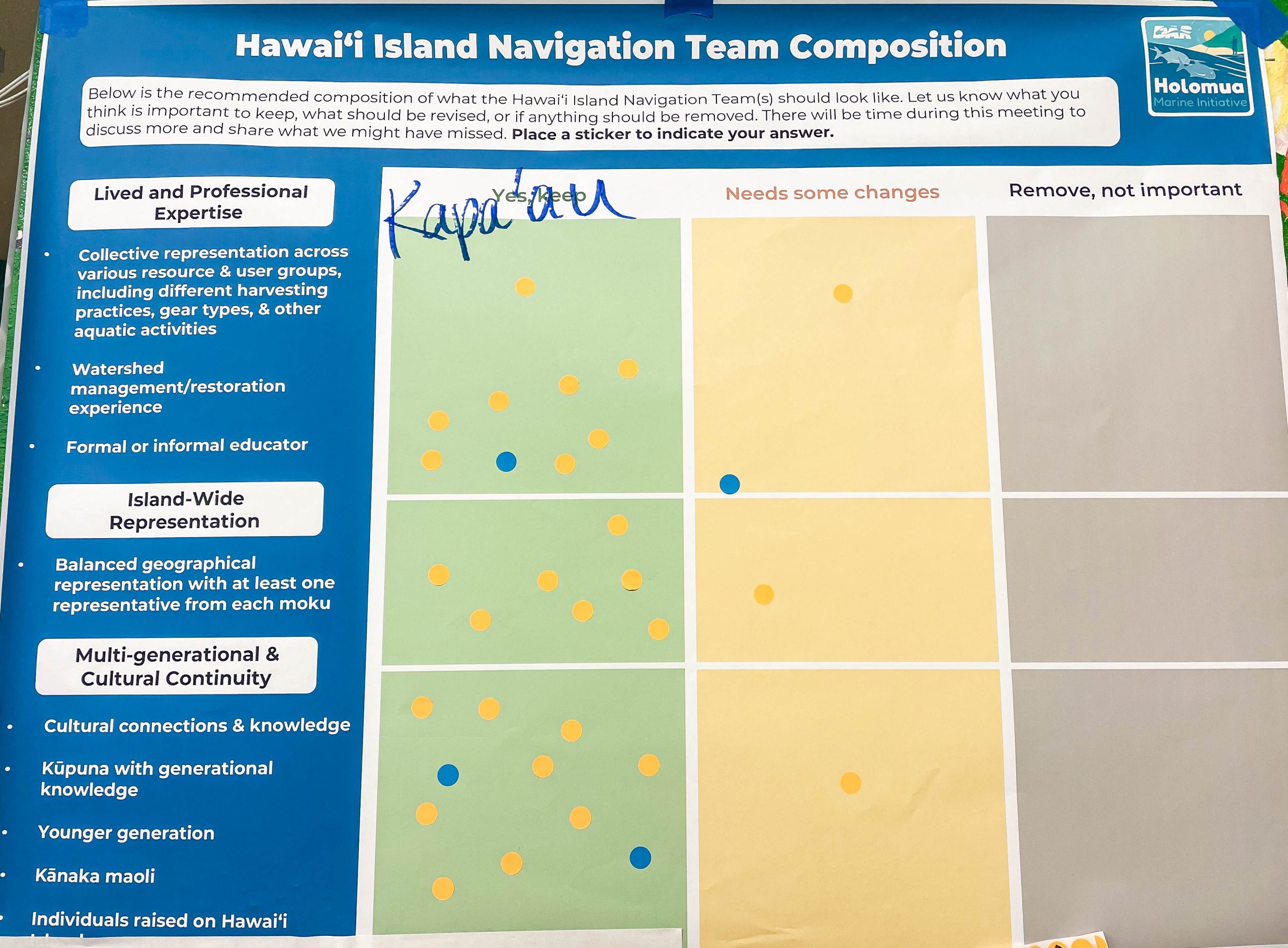
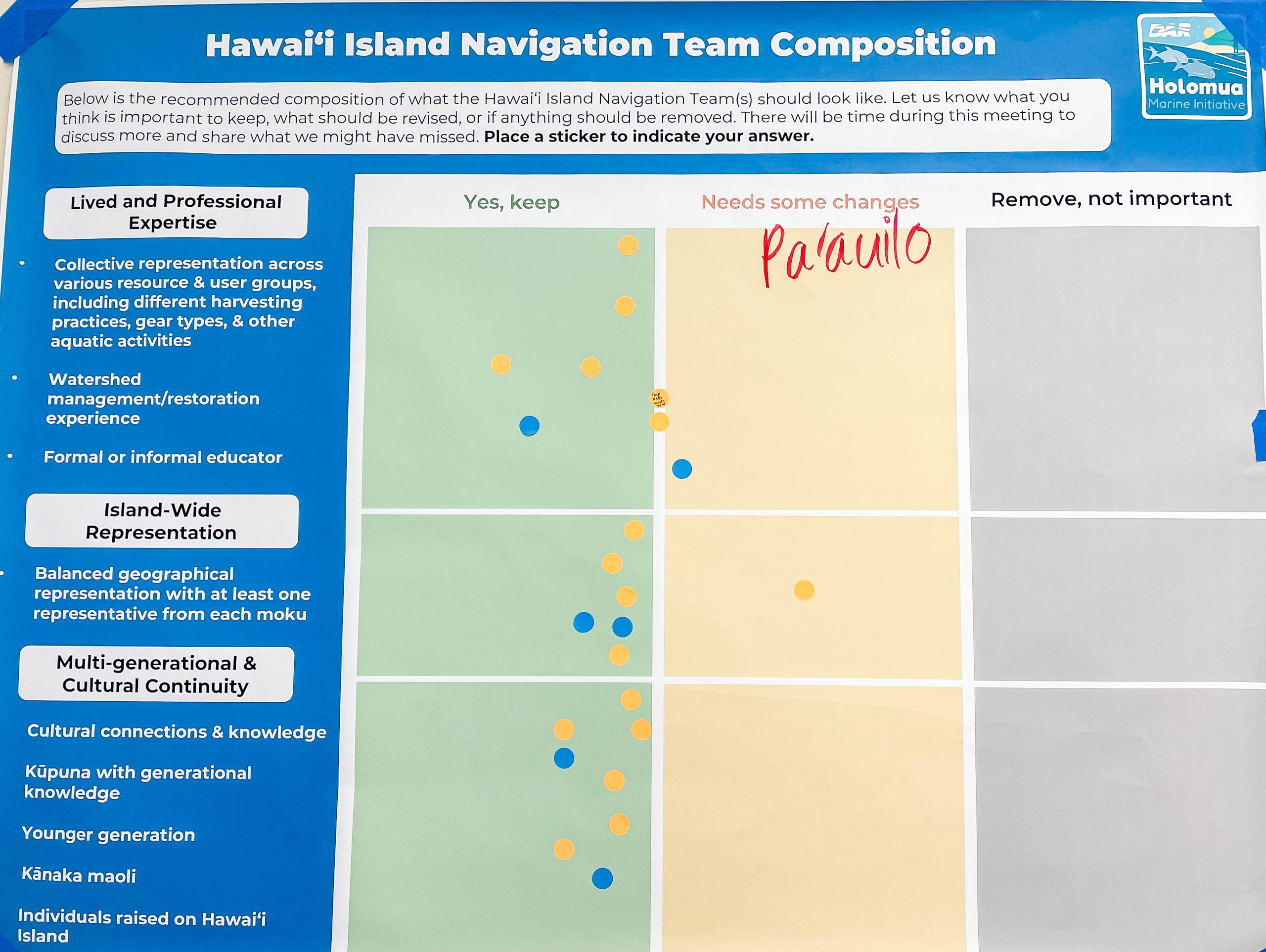
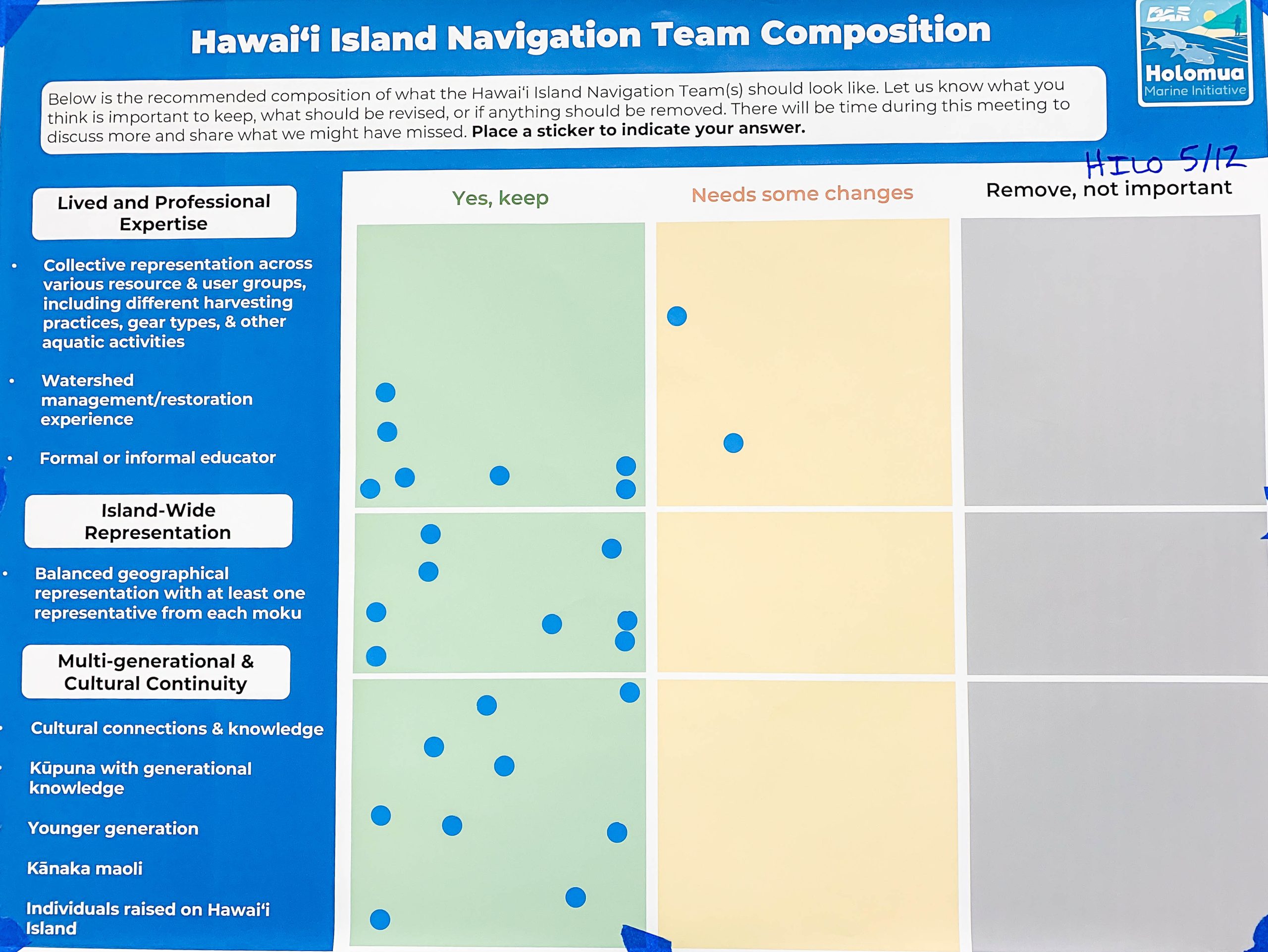
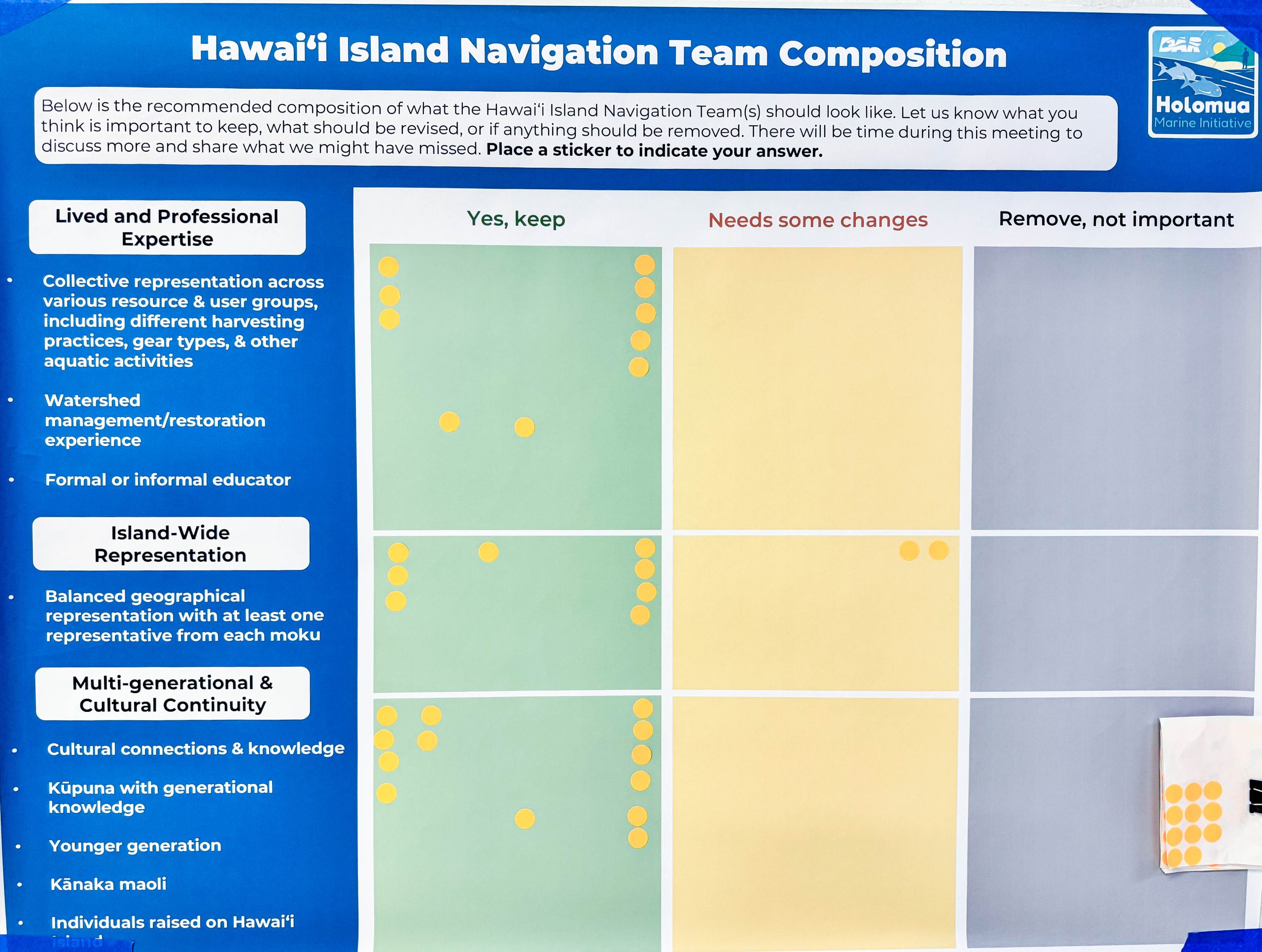
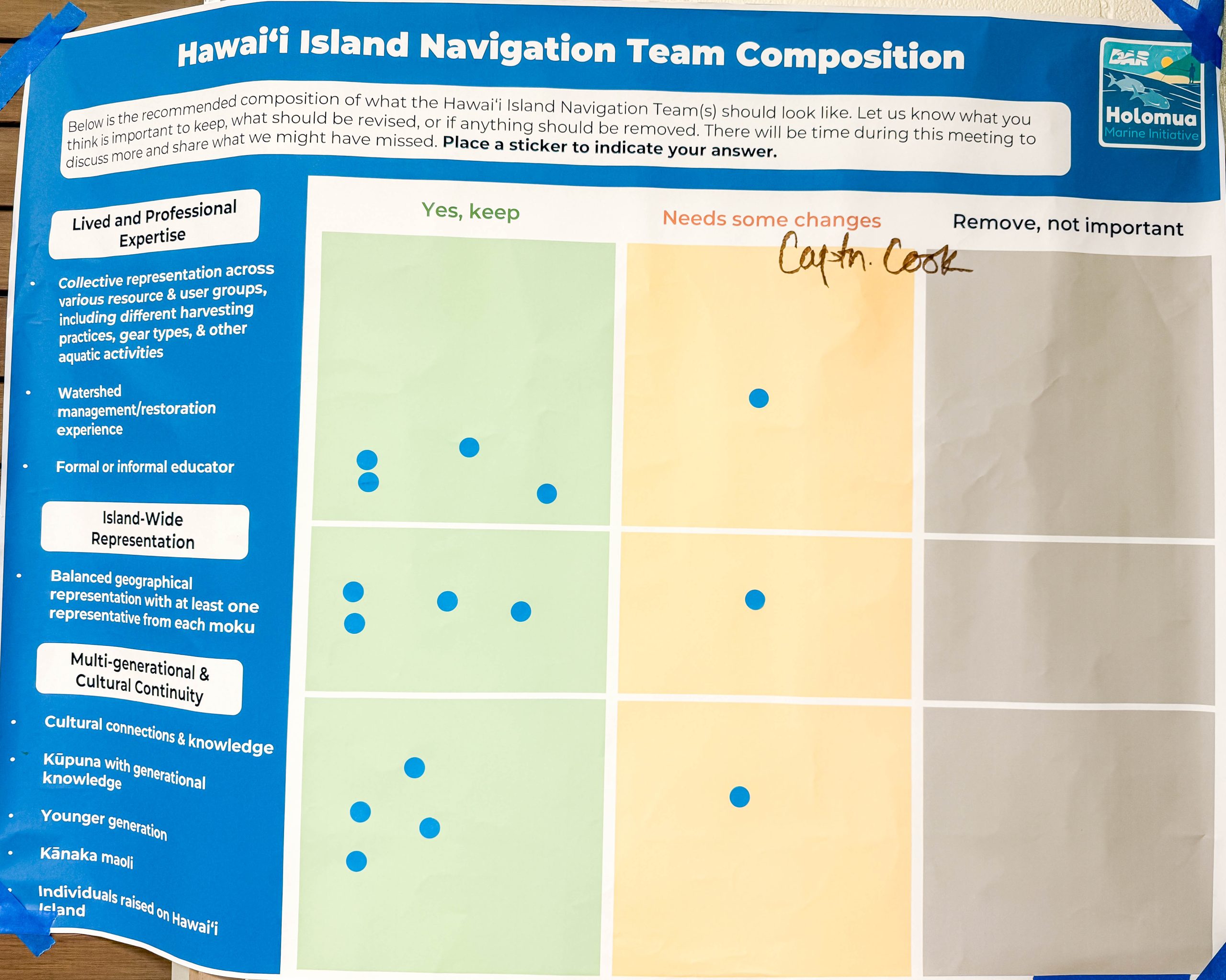
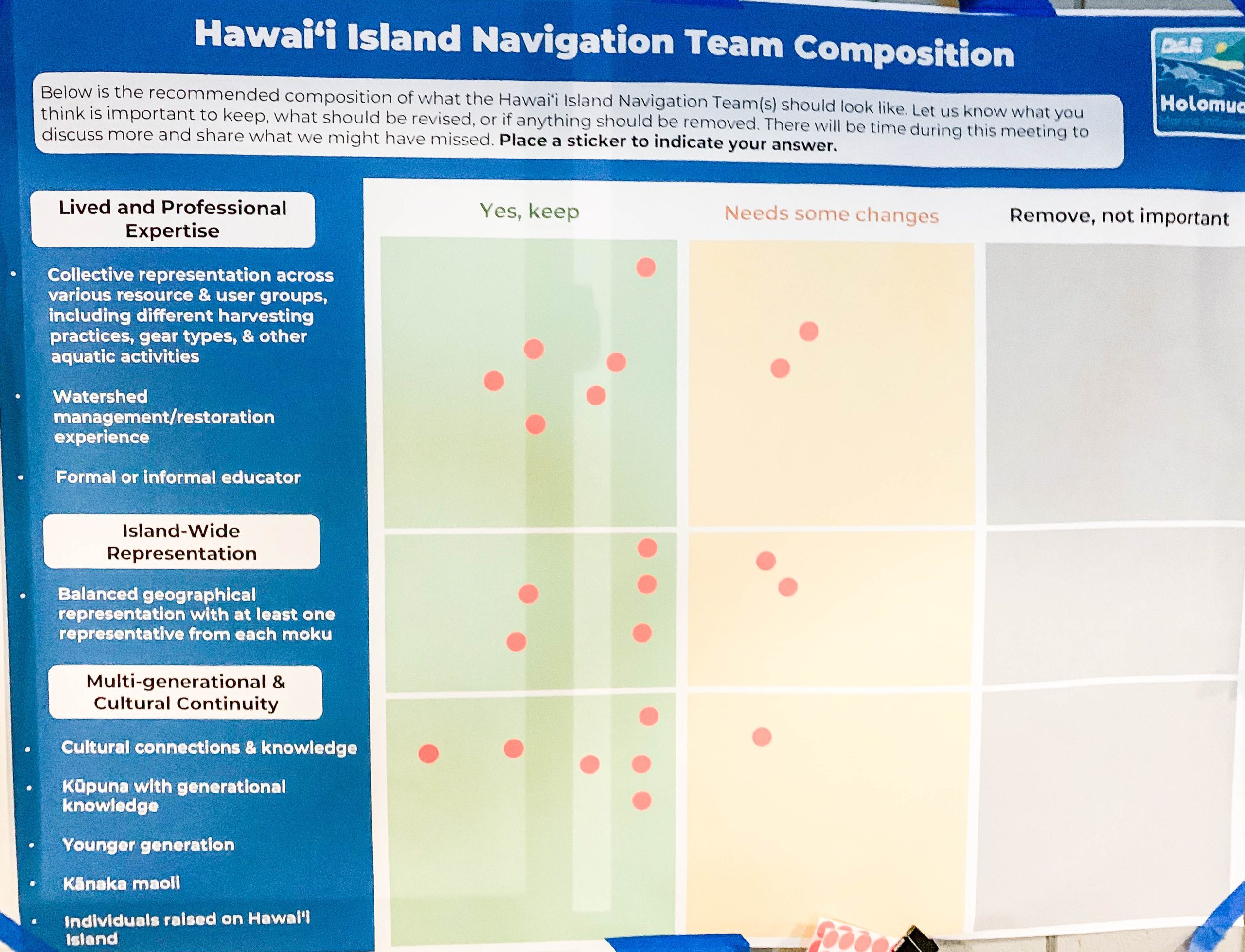
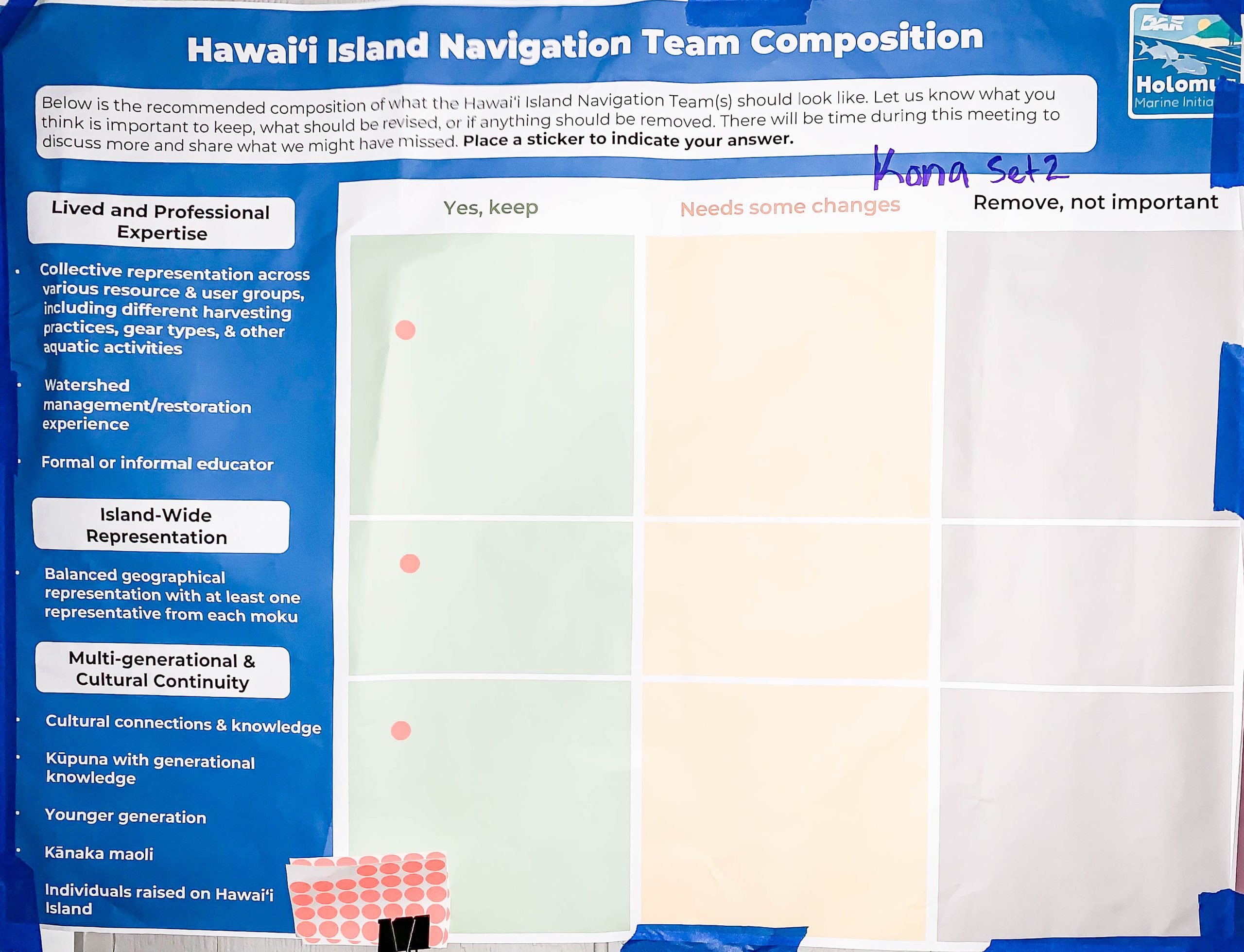
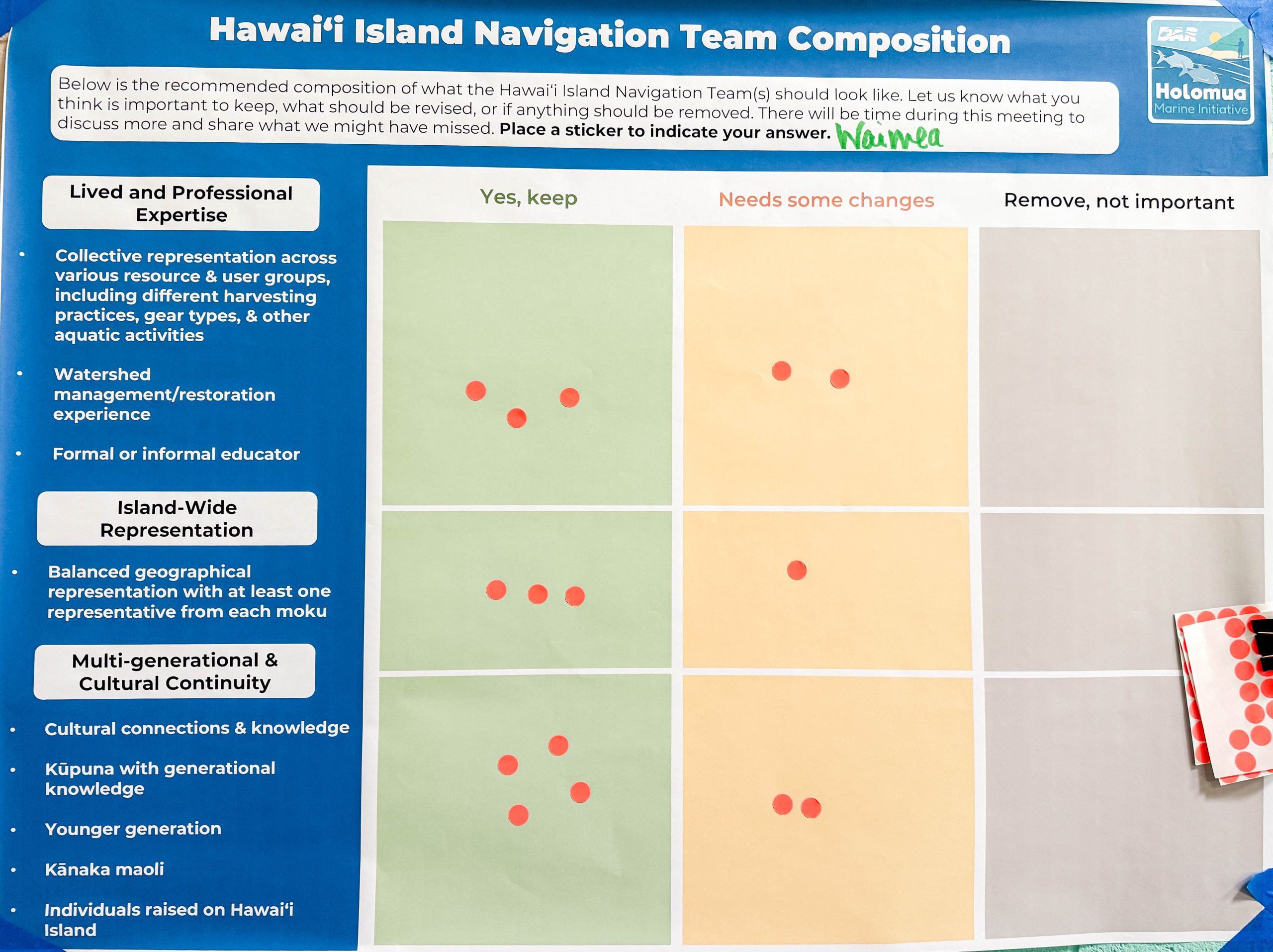
In order to gather feedback on designing the Hawaiʻi Island Navigation Team(s), three interactive posters were used for attendees to share their preferences and input. Responses on these posters were then discussed later in the meeting and participants were able to provide more detail and share their perspectives. Stickers were used to indicate responses on the posters, but it should be noted that not all attendees participated in this activity, and therefore the number of circle stickers do not reflect the number of people that attended the meeting. Additionally, comment cards were also provided so that participants were able to submit more feedback if needed, with some attendees engaging in both the posters and comment cards to share their preferred options.
Navigation Team Qualifications
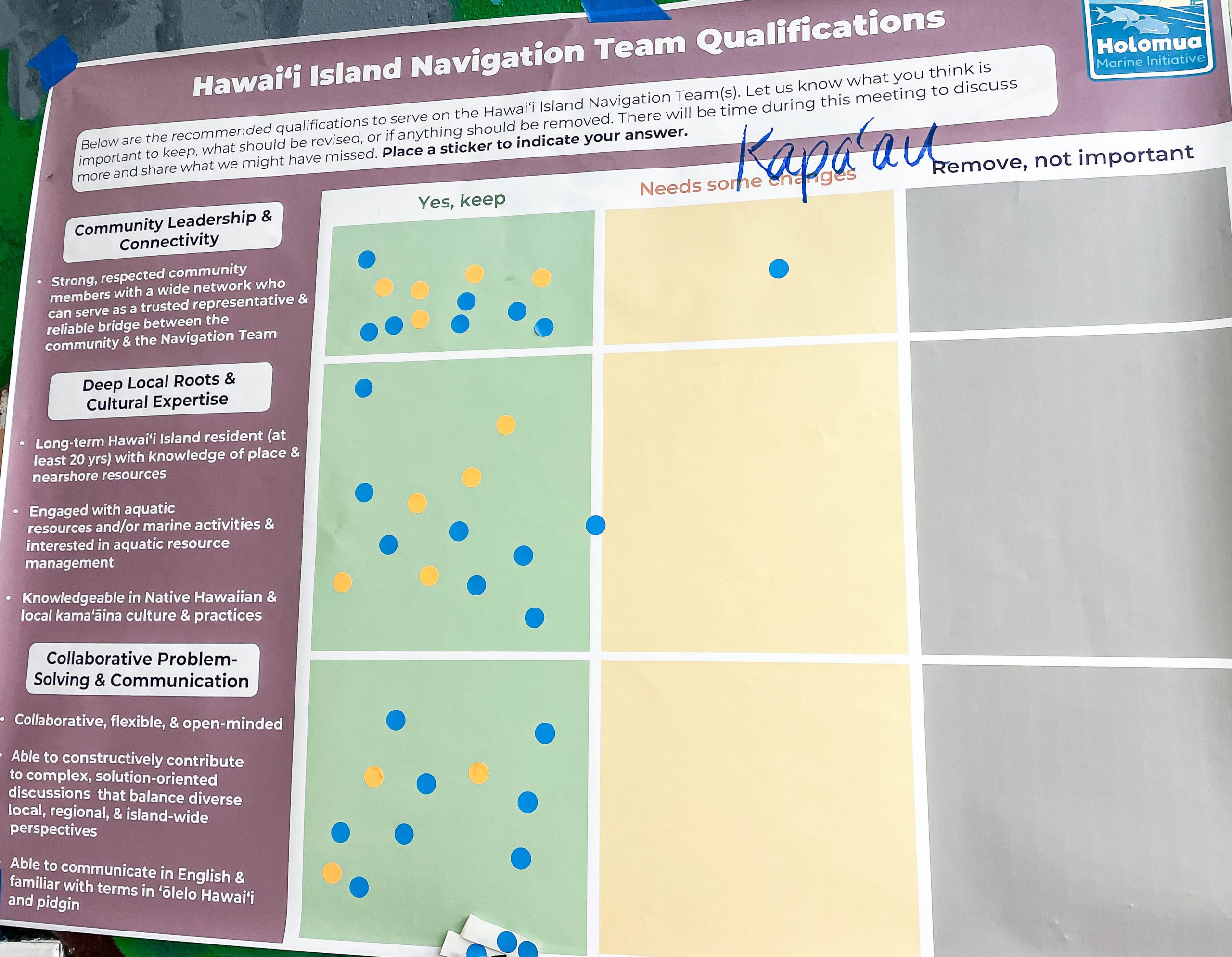
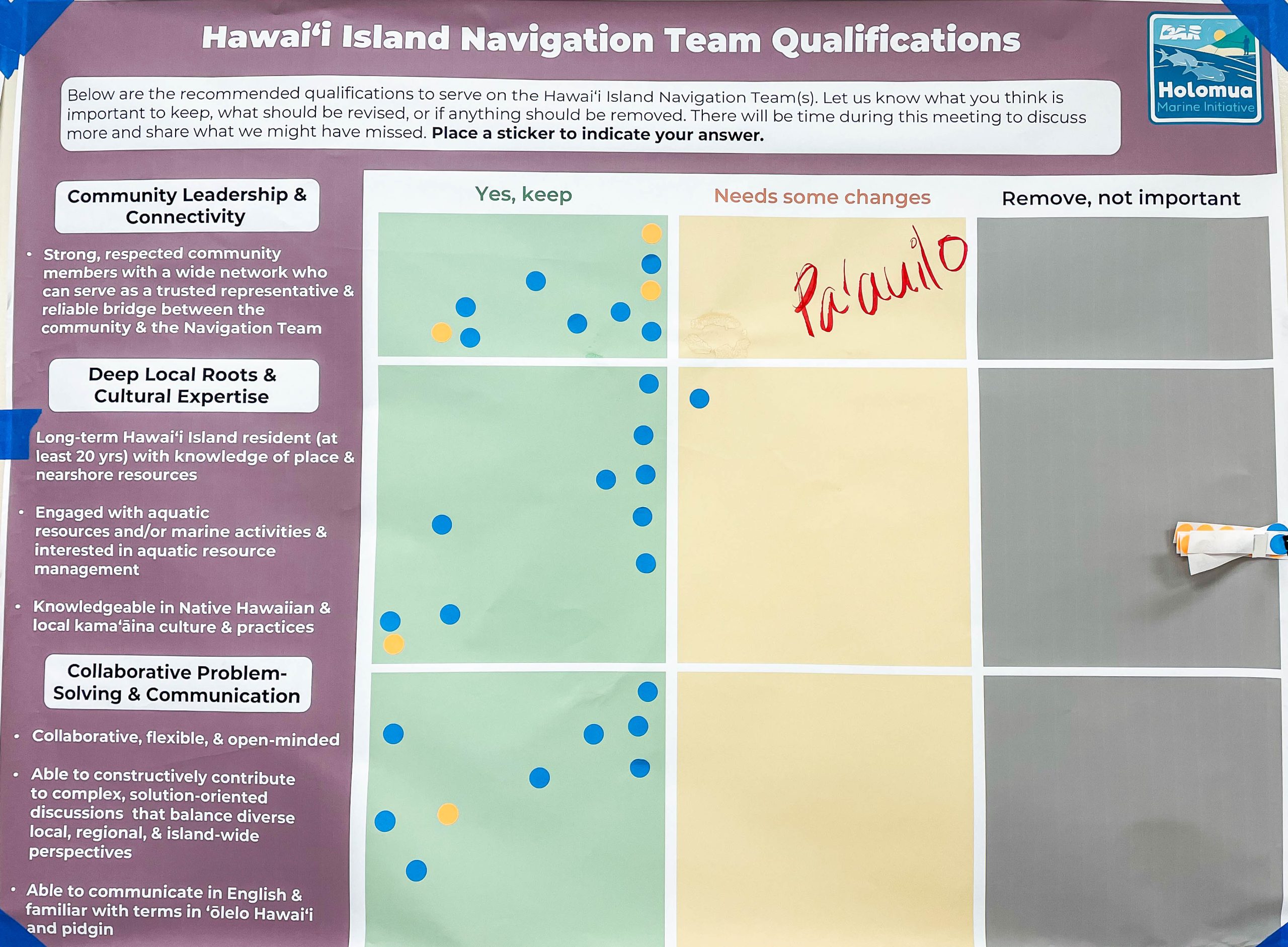
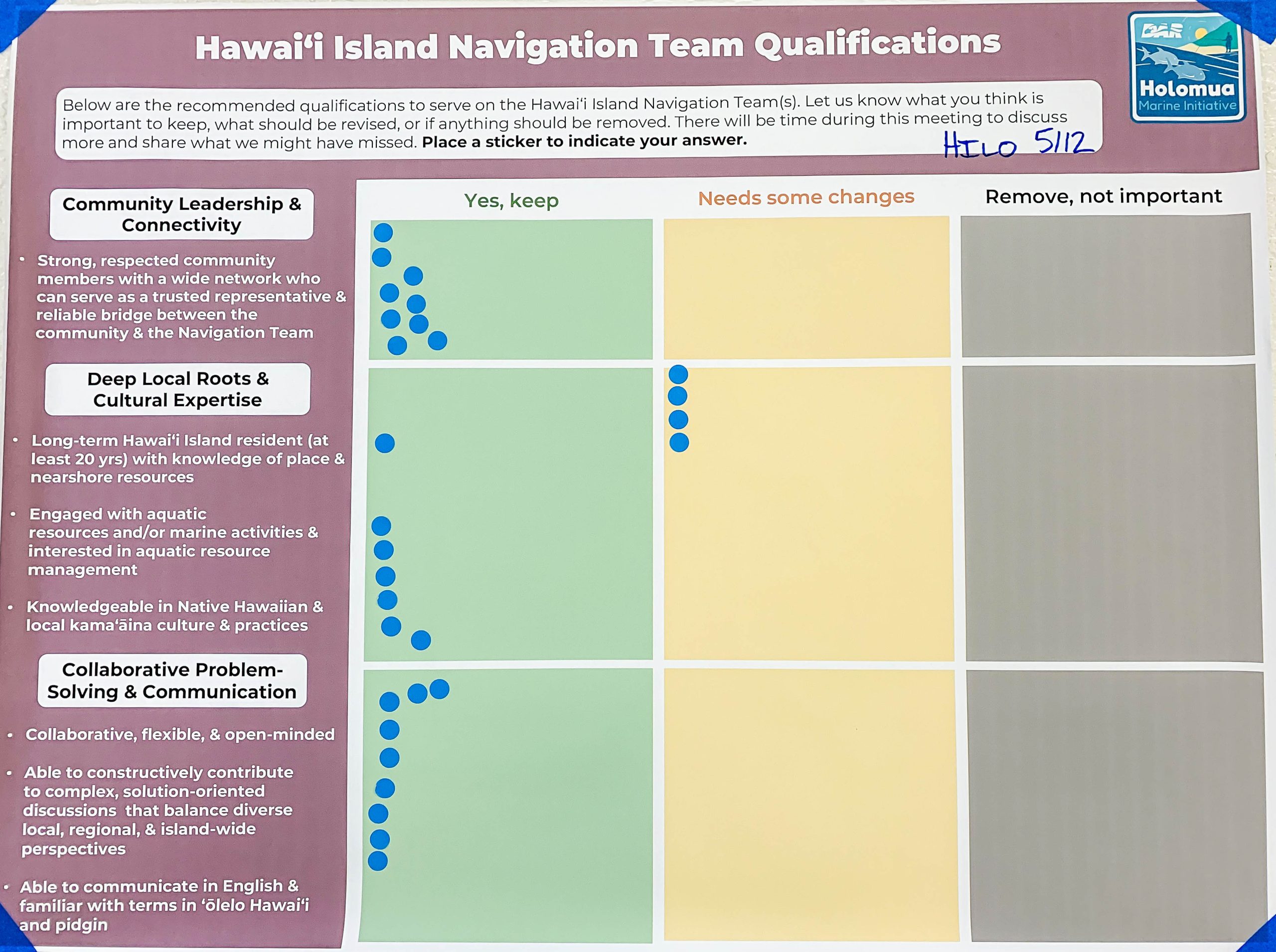
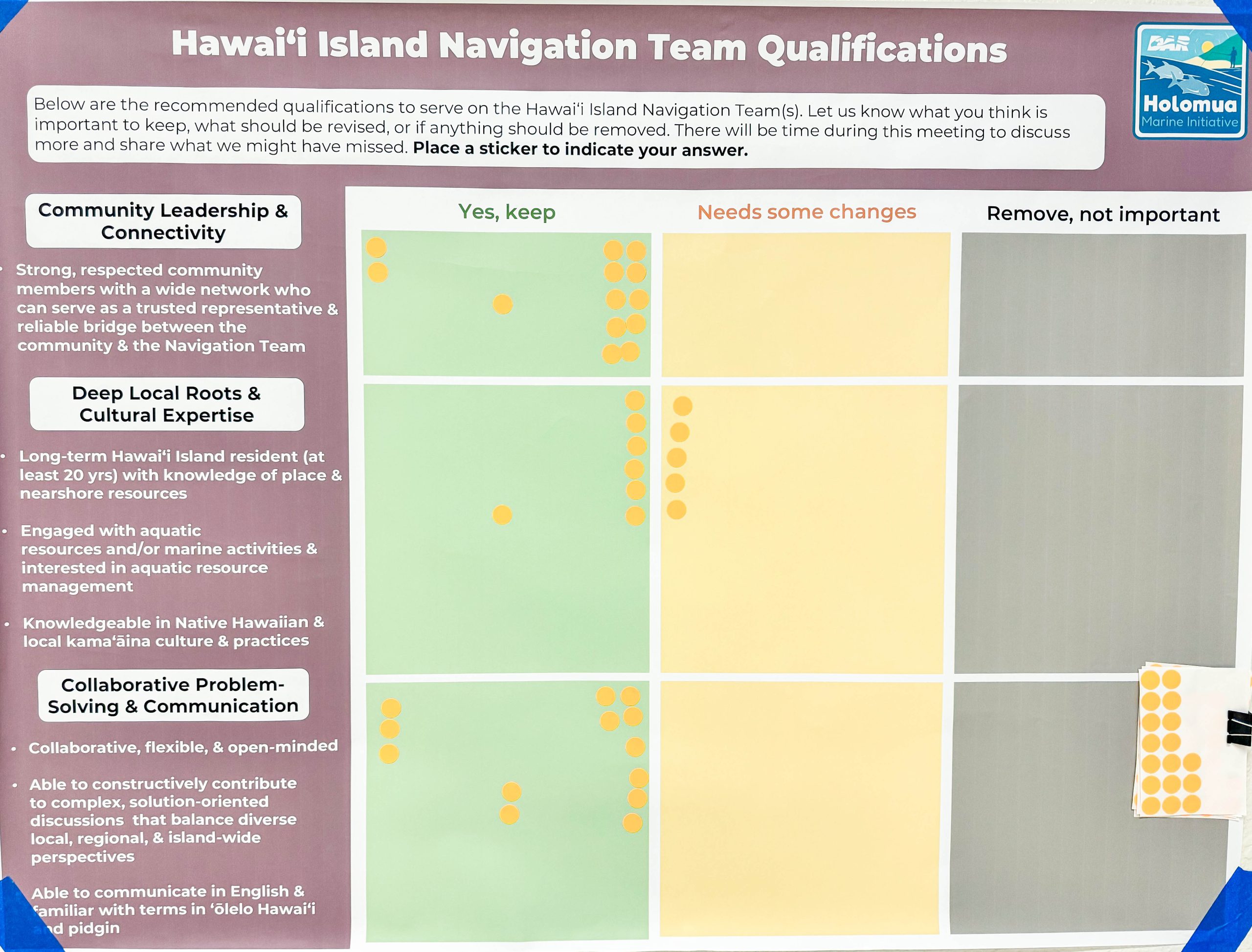
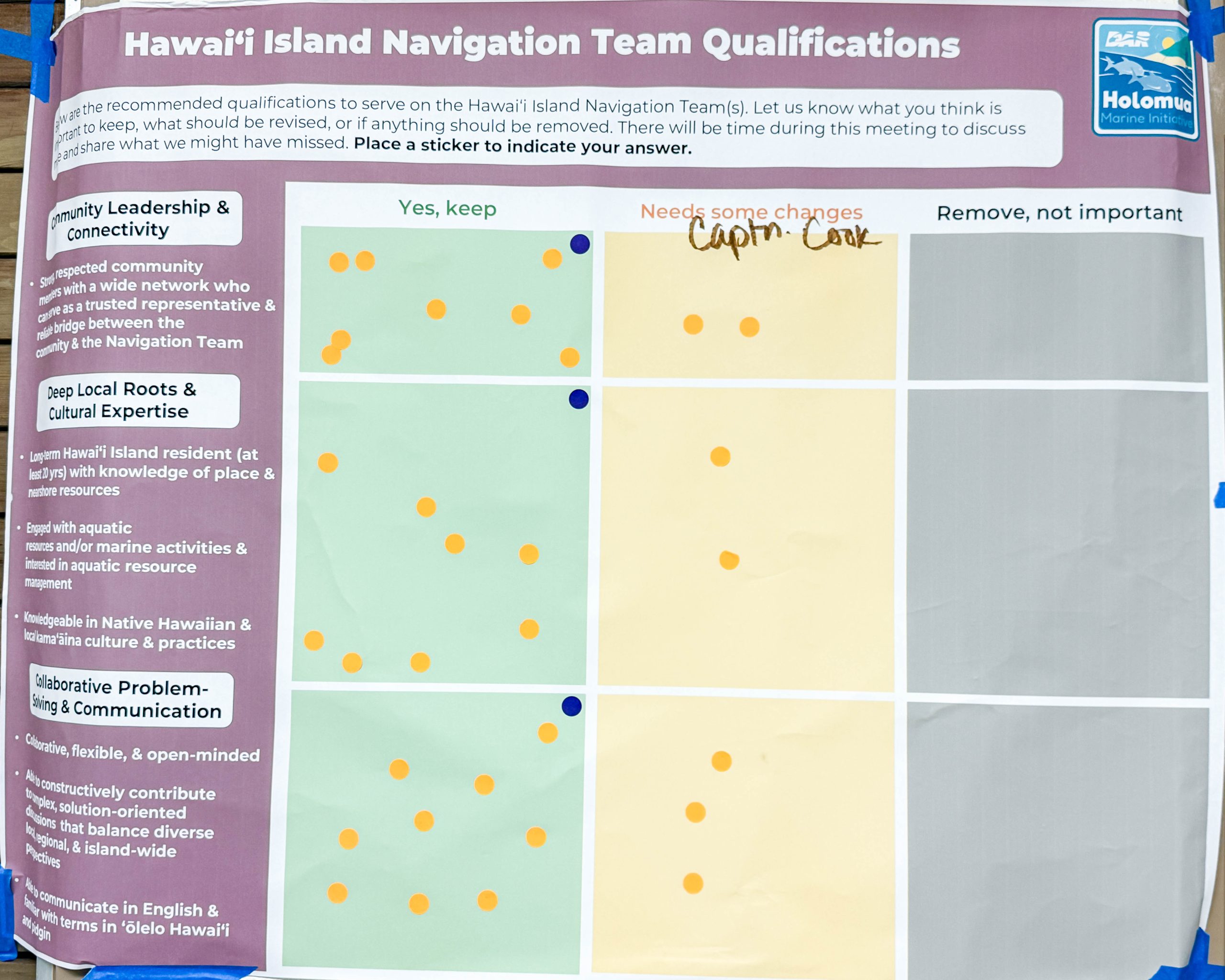
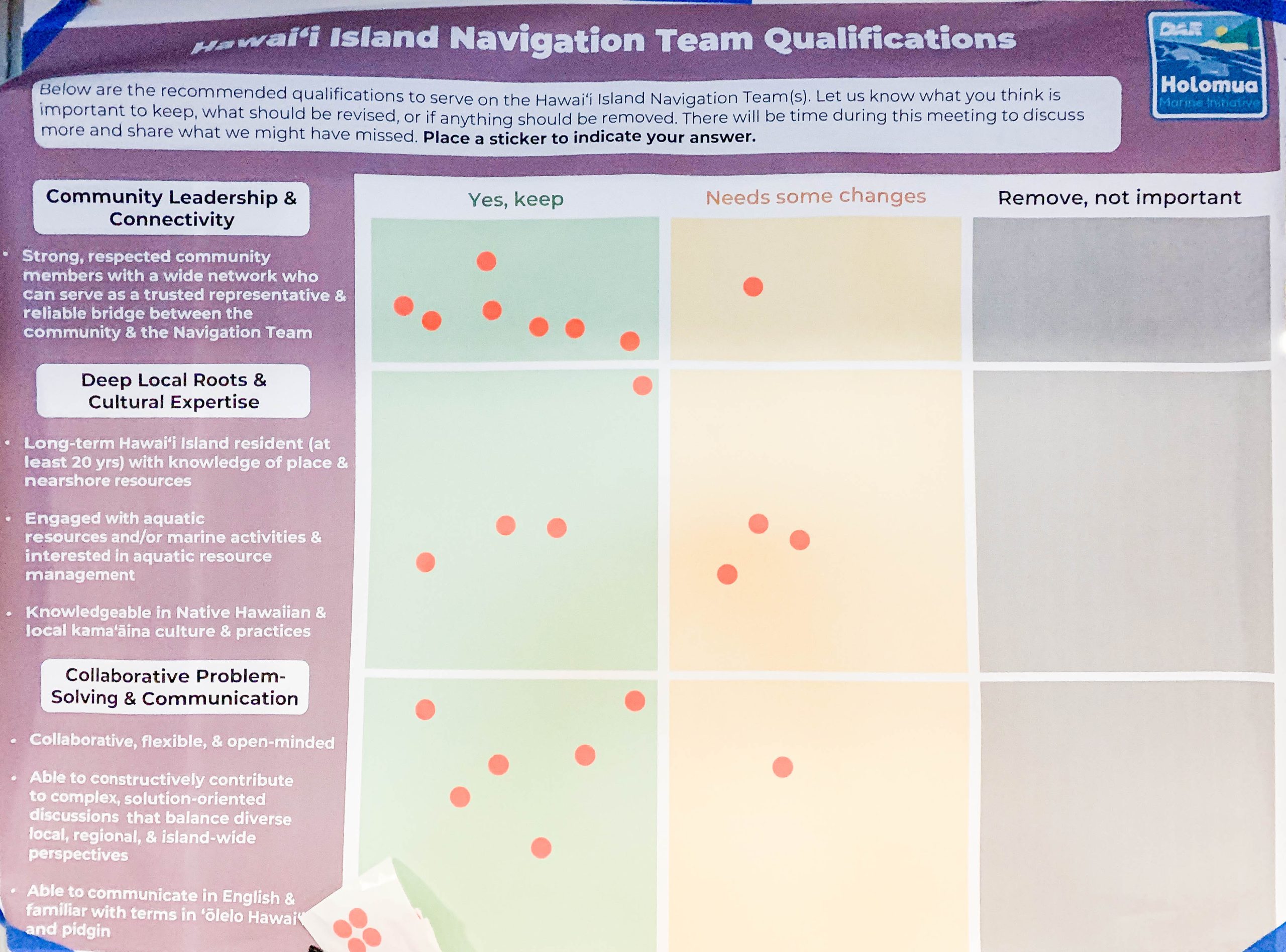
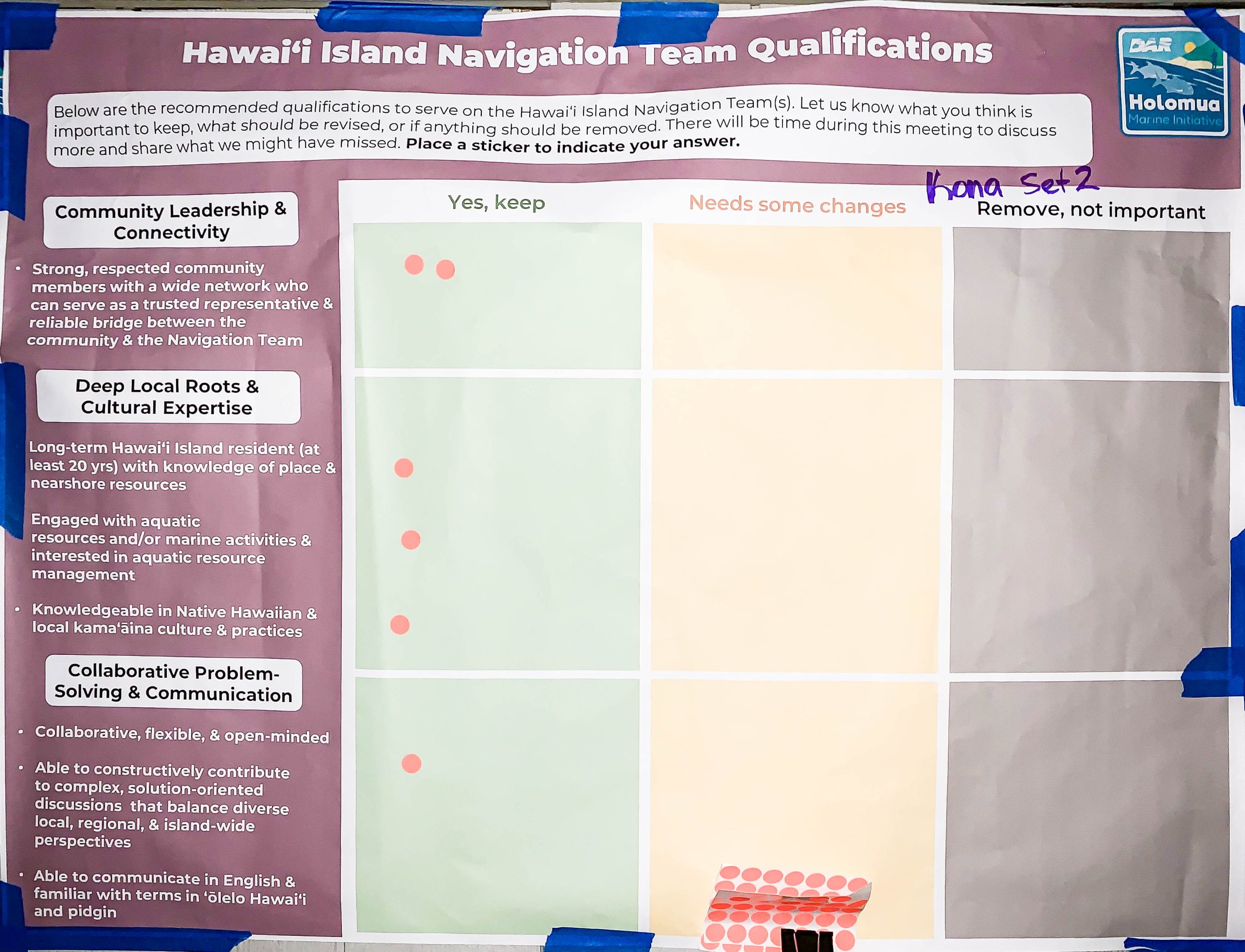
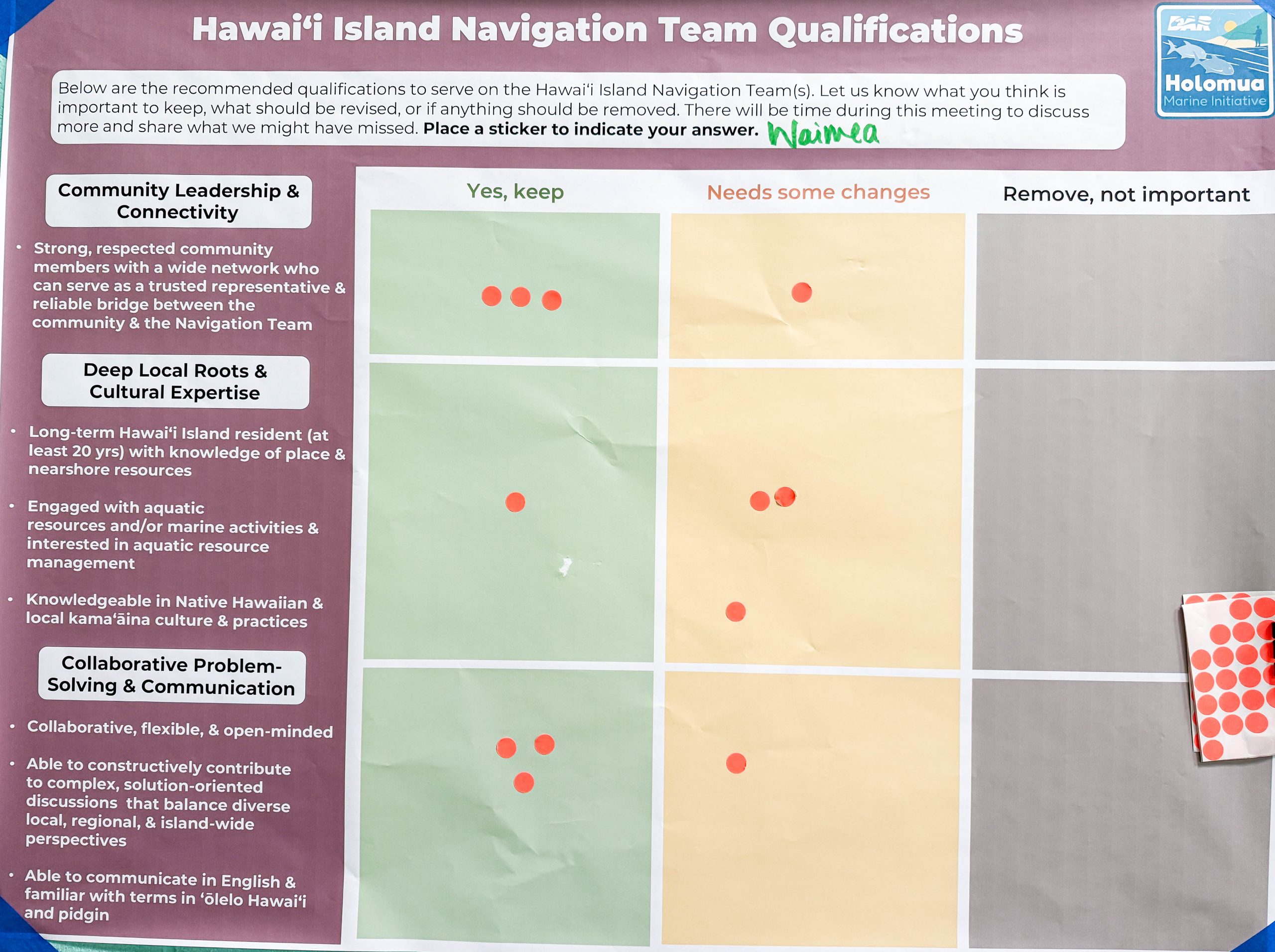
The Navigation Team plays an important role, and having strong members committed to serving on this team is critical. The Holomua team sought input specifically on the skills, experience, and knowledge that should be required of every Navigation Team member. Using the list of qualifications used for the Maui Navigation Team as a starting point, we gathered feedback on what is the best fit for Hawaiʻi Island. Participants used stickers to indicate which qualifications were important to keep, update, or remove, and there was an opportunity to provide more specific feedback on comment cards and through a facilitated discussion.
Overall, there was general agreement on the proposed qualifications with a few new recommendations:
- Length of Residency:
-
- One suggestion that came up repeatedly was that experience should not be defined simply by how long they have been a resident but rather be based on lived experience and knowledge, as some community members with fewer years living on-island may still be deeply connected to nearshore resources and have a lot of experience to bring to the process.
-
- However, some voiced the desire to increase the minimum years of residency required to join the Navigation Team.
- Cultural Connections:
-
- There were recommendations to modify specific words in the descriptions for criteria, such as updating “knowledgeable in Native Hawaiian culture and practices” to “understand” so that it requires deeper comprehension.
-
- Many emphasized the importance of having someone with strong cultural knowledge, especially from ancestral or lineal descendants of the area, and familiarity with traditional management practices.
- Experience in community leadership and place-based stewardship was also highlighted.


Navigation Team Composition
Similarly, feedback was requested on the composition of the Navigation Team as a whole and what sort of representation the team should have to ensure the inclusion of diverse perspectives, local knowledge, and representation across moku, resource user groups, gear types, and harvesting practices.
- The main recommendation that stood out across all the moku was the need for balanced representation, meaning more than one person per moku should serve on the team, and equal numbers of members should be given to each moku.
- There was a focus on ensuring that ʻike kūpuna is included for each area of expertise and emphasis was placed on representation by lineal descendants.
- There were also several suggestions to include a member that is knowledgeable about streams and rivers, and to redefine “watershed management experience” to be more inclusive such as focusing on the principles of aloha ‘āina.
- The need for representation from those involved in policy, management and environmental case law was also expressed.


Navigation Team Organization
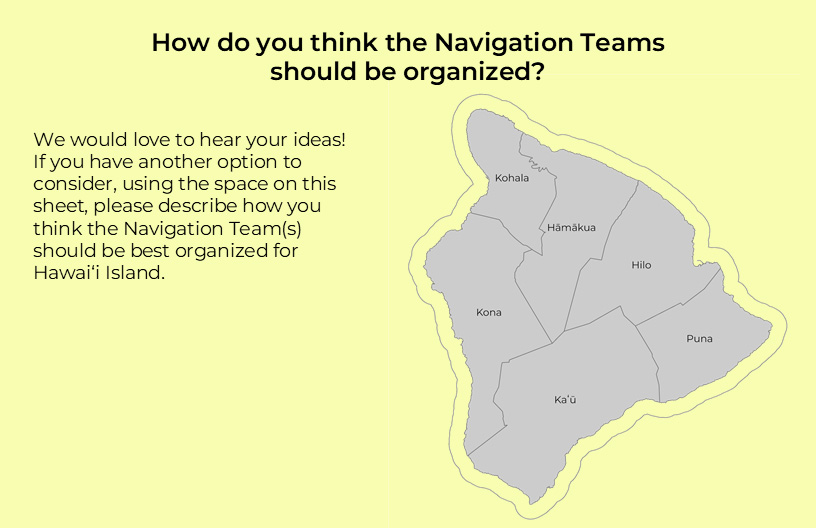
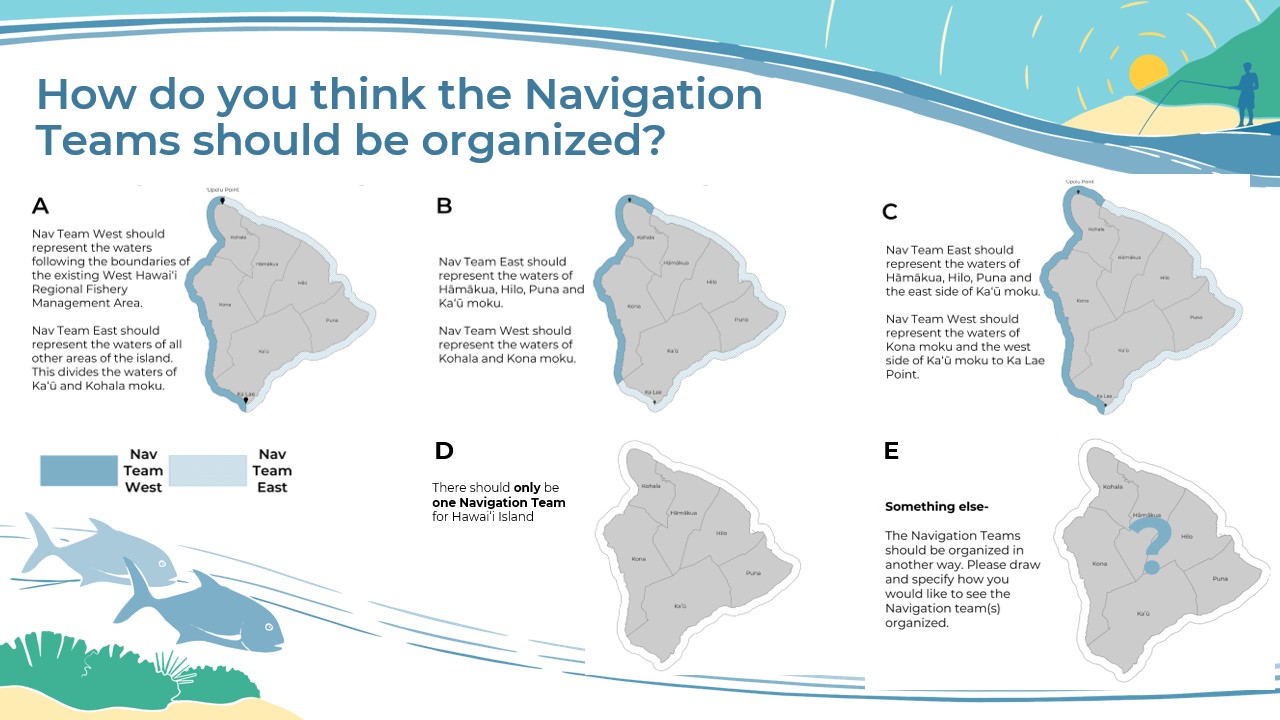
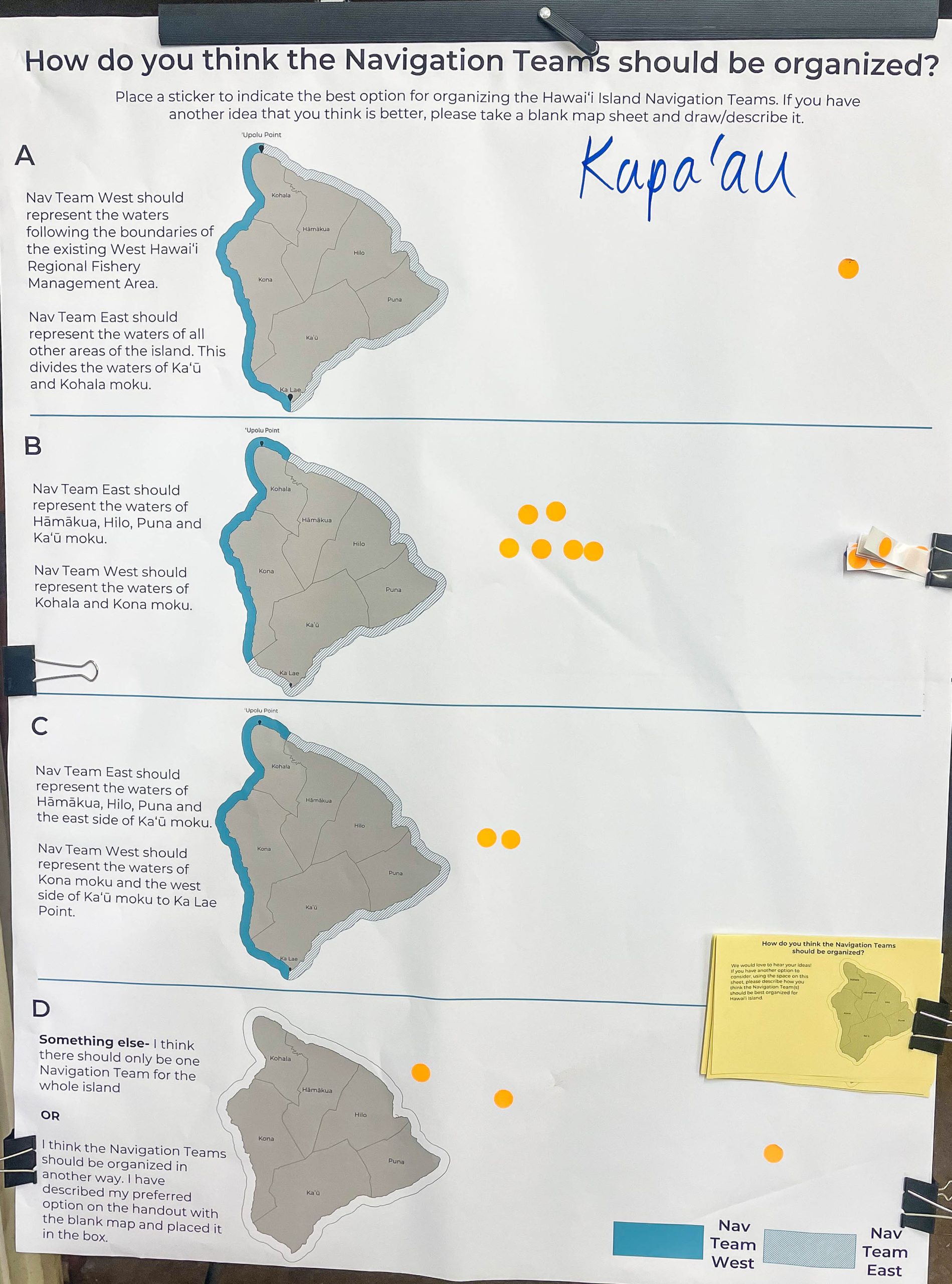
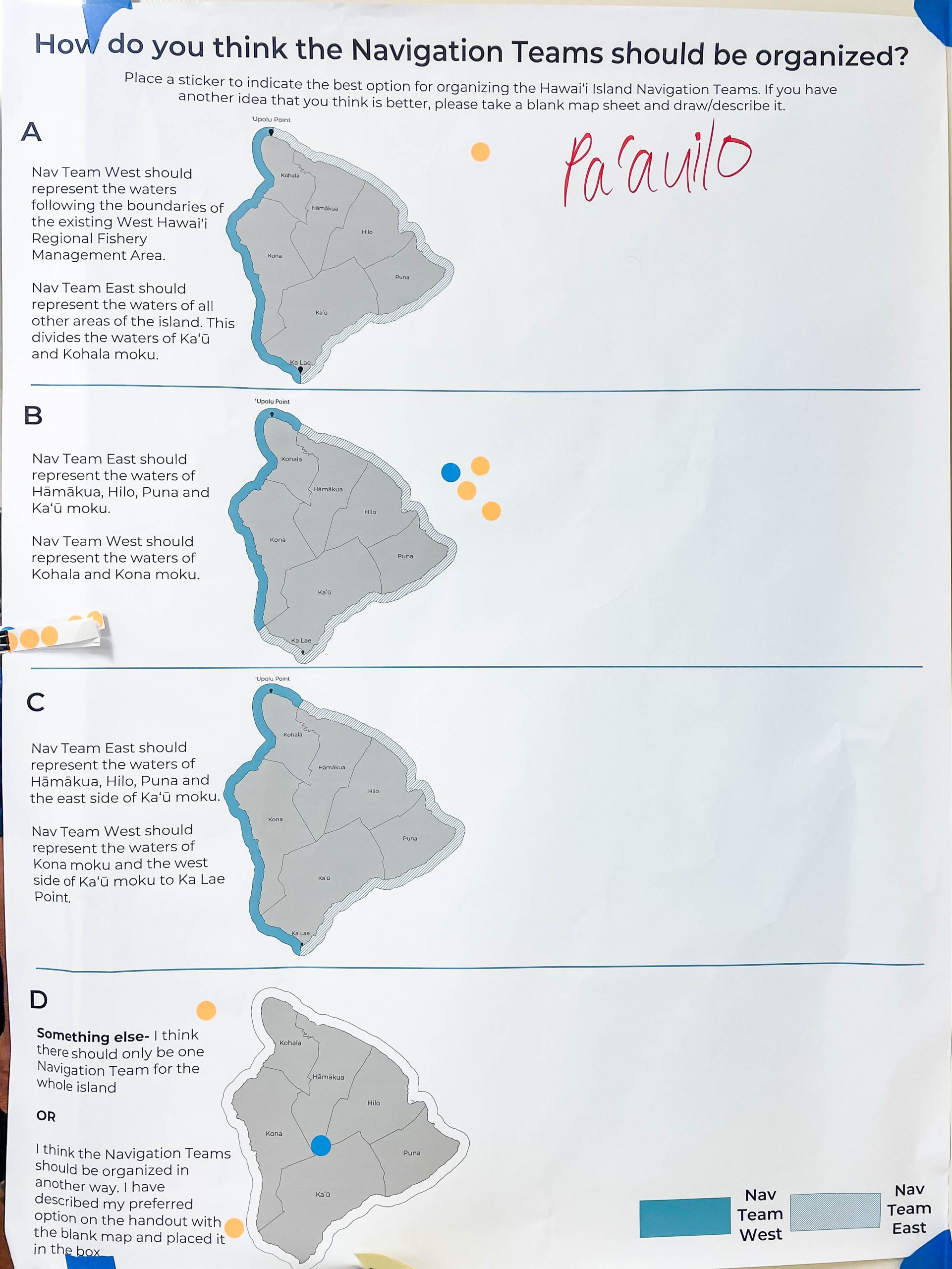
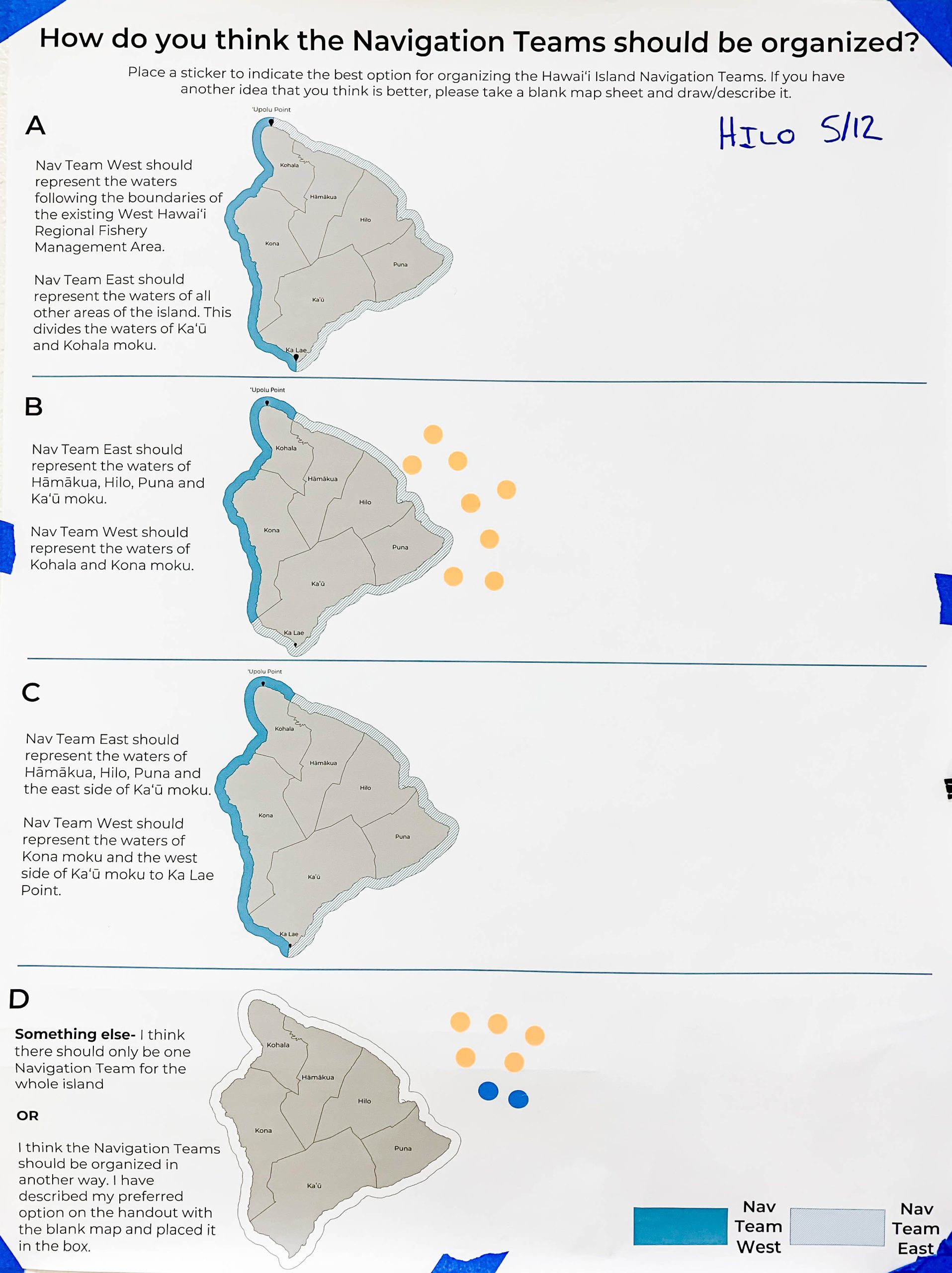
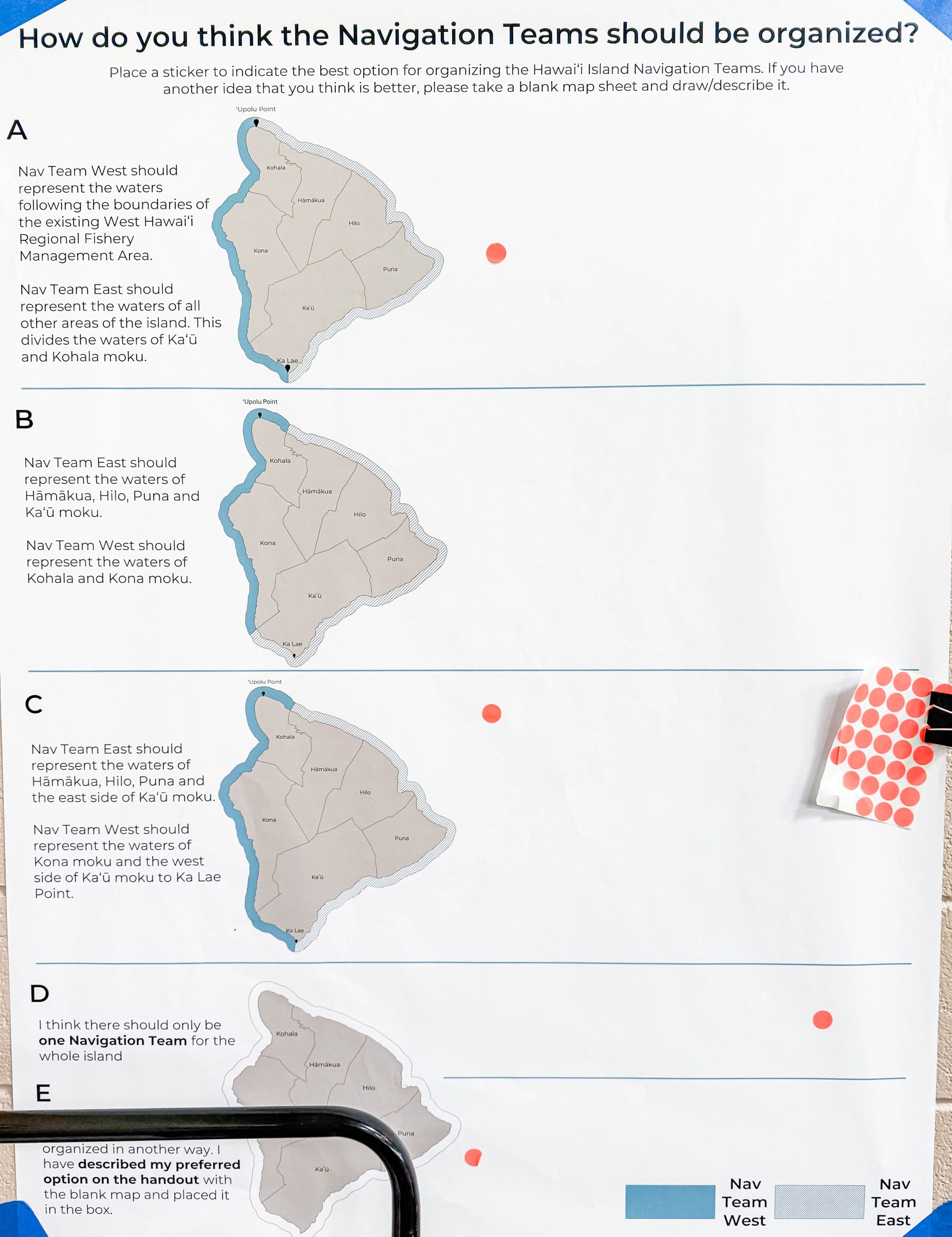
Lastly, given the size and diversity of Hawai‘i Island, input was also collected on how the Navigation Team(s) should be organized. While Maui had just one Navigation Team, consideration is being given for Hawaiʻi Island to potentially have more than one team that may alternate working separately and then together as a full group throughout the process. Attendees were asked to put a sticker next to the option they thought was best, but also had the option of filling out a paper map where they could provide other alternatives or comments.
Many different options were proposed, but one key priority identified was that each moku should be well represented, regardless of how the teams are organized or how many teams are created.
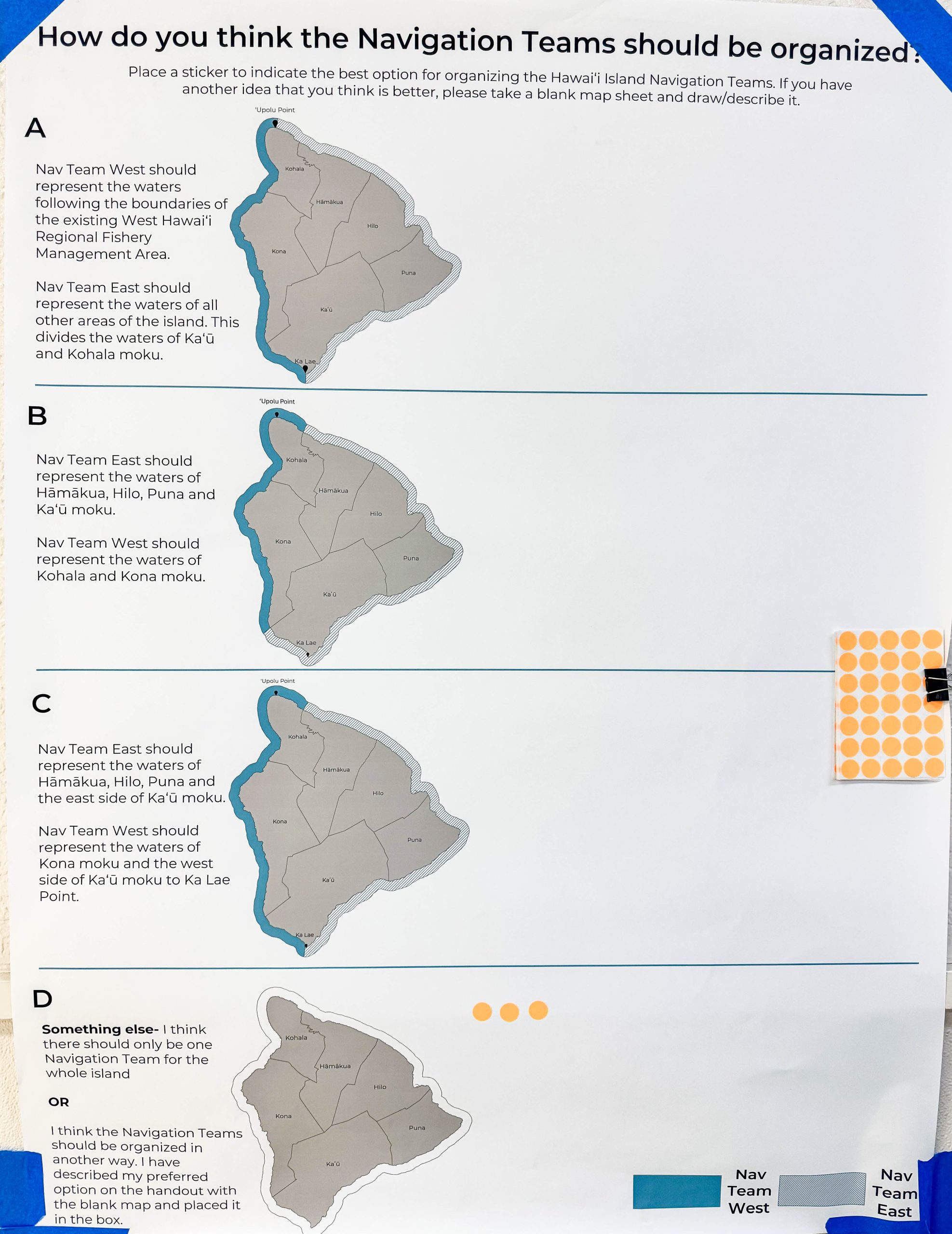


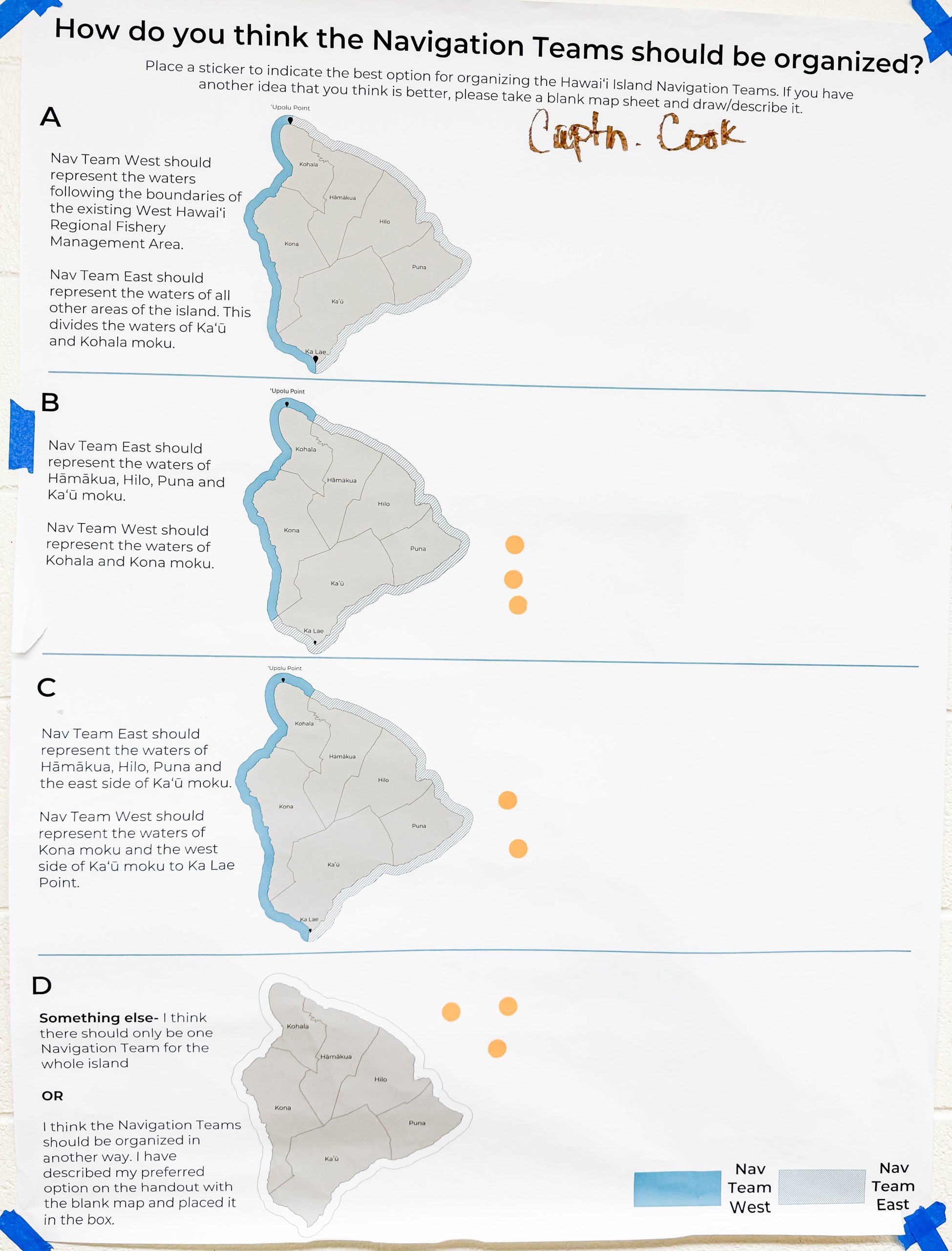
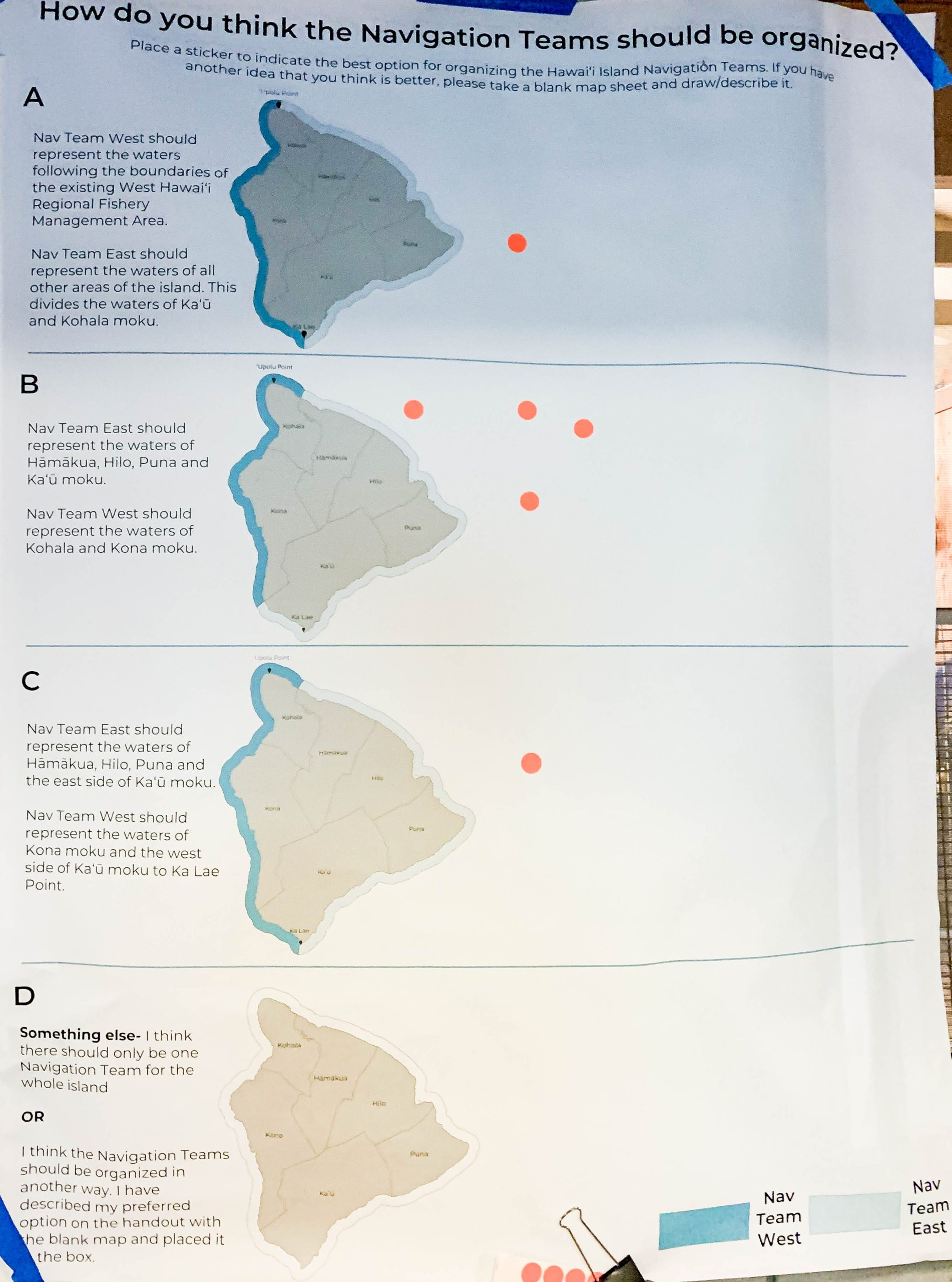
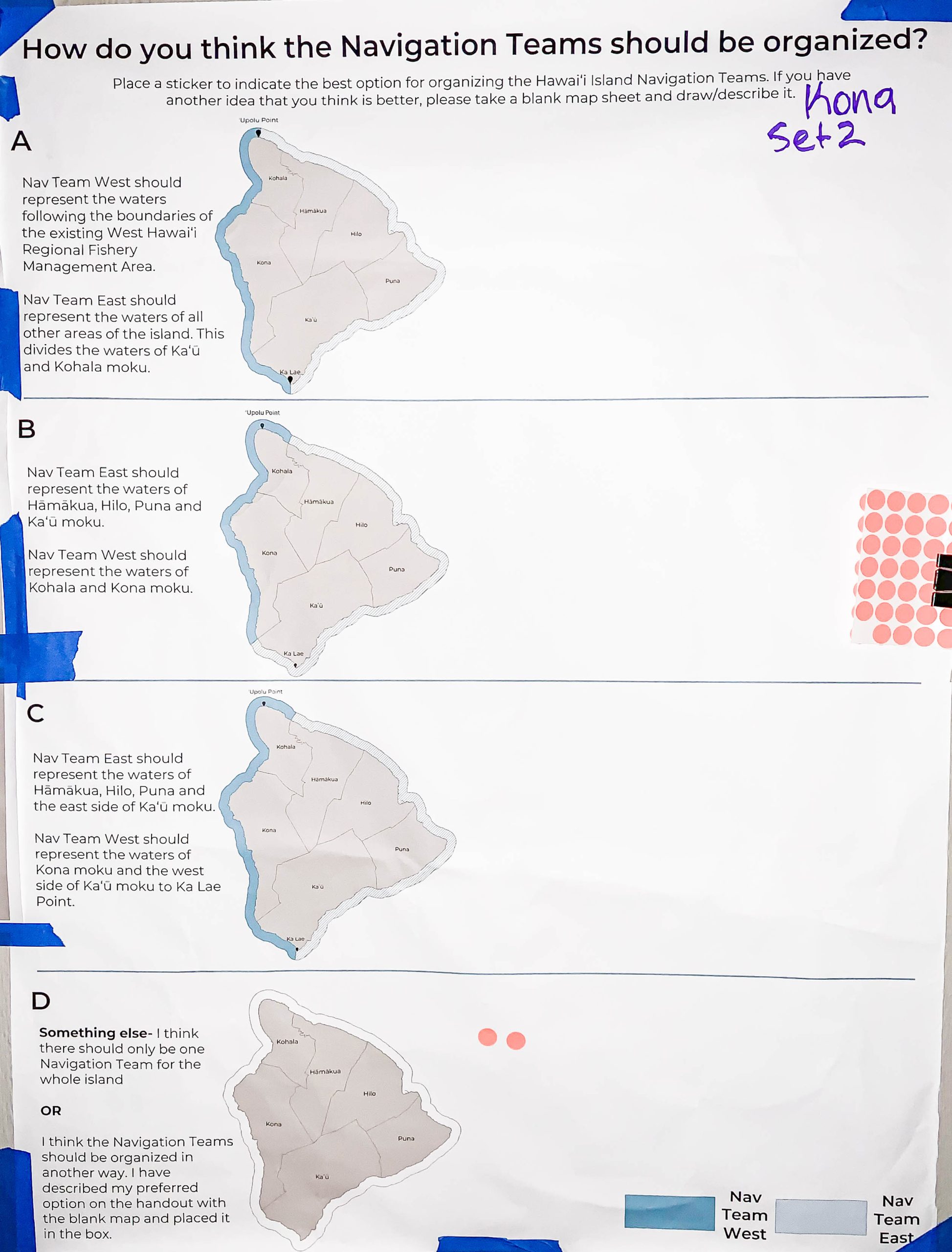
Click the links below to view the additional suggestions on Navigation Team Organization