New Dashboard Highlights Hawaii Most Reported Invasive Species
Posted on Jan 28, 2026 in News, sliderNew 643pest.org Invasive Species Trends Dashboard Turns Community Reports Into Early Detection Insights
The Hawaiʻi Invasive Species Council (HISC) has launched a new Invasive Species Trends Dashboard on 643pest.org, transforming more than 15 years of pest reports from community members into live, searchable trend data.
Powered by reports submitted across the islands, the Invasive Species Trends Dashboard acts as a real-time “smoke alarm” for invasive species impacts in Hawaiʻi. Over time, this community-generated data reveals patterns that help guide early detection, outreach, and response efforts statewide.
Invasive Species Trends Dashboard
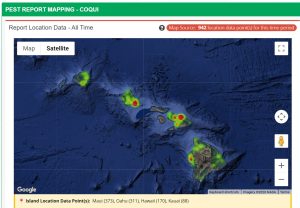
Example view of community-reported coqui frog hotspots across Hawaiʻi (click to explore live data).
The new dashboard brings together more than two decades of community reporting into one interactive tool. Users can explore trends for Hawaiʻi’s most frequently reported invasive species, view changes over time, and compare patterns across islands.
Because reports are reviewed before being displayed and locations are privacy-protected through clustering, the dashboard provides reliable, public-facing insights while safeguarding personal information.
Explore the New Dashboard
Community reporting has helped shape Hawaiʻi’s invasive species response for more than 15 years. Now those trends are visible to everyone. Explore the Invasive Species Trends Dashboard →
By the Numbers: A Snapshot from FY25
In fiscal year 2025 alone, 643pest.org received more than 1,500 pest reports statewide, representing over 100 unique species. Nearly half of those reports were for pests already considered widespread and resulted in direct community guidance, while others were forwarded to response agencies such as HDAB, DLNR, and Island Invasive Species Committees for follow-up.
Major reporting spikes over the years — such as those tied to Coconut Rhinoceros Beetle — illustrate how awareness and visible impacts influence reporting trends.
Reading the dashboard with response in mind
Pest report trends often mirror the general spread of a pest as shown in the invasion curve. In many cases, species are first noticed only after they have begun rapid growth and spread, well past the window when early detection and low-cost eradication are possible.
How to Read the Trends: The Invasion Curve
Invasive species growth and spread often follow a predictable pattern known as the invasion curve.
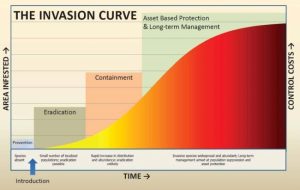
The Invasion Curve, adapted from Invasive Plants and Animals Policy Framework/State of Victoria, Department of Primary Industries, 2010, Public Domain, https://www.fws.gov/media/invasion-curve
At first, populations are small and difficult to notice. During this early stage, detection and eradication are most effective and lowest cost. Tools such as surveys and monitoring traps are often used to find these “needles in a haystack.”
As time goes on, species spread, become more visible, and impacts increase. This is generally when people tend to notice a new plant, animal, or insect. Unfortunately, this often means the species has already entered the containment phase, where eradication becomes much harder or no longer possible. At this stage, efforts shift toward protecting ecologically, agriculturally, culturally, or financially significant areas.
Kilo, the practice of careful observation and awareness of the world around us, becomes essential. By practicing kilo and noticing changes in landscapes, gardens, parks, and neighborhoods, community members play a critical role in detecting new species and emerging populations early.
So what’s the point of reporting if an organism is already widespread?
Reports still matter. Submissions can trigger identification support, follow-up questions, and referrals to response partners when action is needed. They also act as a “smoke alarm,” showing where impacts are being felt and where communities can work together on management and in some cases, helping detect new populations that can still be controlled.
The pest hotlines, 643-PEST and 643pest.org, were created to support early detection, connect community members with trusted identification and management information, and ensure reports lead to action by appropriate agencies and partners.
Every report strengthens our collective ability to respond and protect Hawai’i.
Recent media coverage:
Hawaiʻi Public Radio – Invasive species dashboard compiles a decade of reports
Civil Beat – Hawaiʻi residents are keeping a keen eye on invasive species