Invasive Ramie Moth Recently Detected on Kauaʻi and Lānaʻi
Community Reports Highlight Ongoing Interisland Spread
Recent detections of ramie moth (Arcte coerula) on both Kauaʻi and Lānaʻi mark the continued spread of this invasive insect across the Hawaiian Islands. A December community report to the Kauaʻi Invasive Species Committee (KISC) led to the first confirmed detection on Kauaʻi. Additional community reports submitted following a January press release indicate the ramie moth may now be present in multiple areas on the island.
Separately, a report submitted through Hawaiʻi’s statewide pest hotline, 643pest.org, in January confirmed a ramie moth larva on māmaki on Lānaʻi. Ramie moth was first detected in Hawaiʻi in November 2018 in Olowalu, West Maui. Since then, it has spread to East Maui, Hawaiʻi Island (2020), Oʻahu (2025), Kauaʻi (December 2025), and Lānaʻi (January 2026).
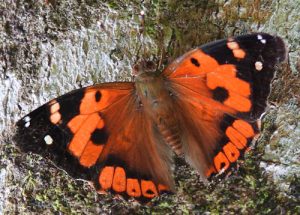
The endangered Pulelehua (Kamehameha butterfly) relies on native Hawaiian nettles, making the invasive Ramie Moth a competitor. Image courtesy CTAHR.
A Threat to Māmaki and Native Forest Ecosystems
Ramie moth caterpillars are voracious feeders of māmaki (Pipturus spp.), a native plant of ecological, cultural, and agricultural importance in Hawaiʻi. Larvae can rapidly defoliate entire plants.
This invasive moth also feeds on other endemic nettles, including maʻoloa (Neraudia spp.) and ōpuhe (Touchardia sandwicensis). Reductions in these native plants can impact native insects, including the endangered Pulelehua or Kamehameha butterfly, Hawaiʻi’s state insect, whose caterpillars depend on native Hawaiian nettles as host plants.
Identification
Caterpillars range from 1/16 inch to nearly 4 inches long as they mature. Larger larvae are typically black with bright orange-red spots, yellow markings along the sides, and thin white hairs. Ramie moth larvae are also known for aggressive defensive behavior. When disturbed, they rear up their head, thrash, and may regurgitate a green liquid.
Adult moths are dark brown with black and silvery wing markings and wingspans up to 3.5 inches.
Because ramie moth caterpillars can resemble those of the Kamehameha butterfly and are found on the same native Hawaiian nettle family host plants, careful identification is critical.
Ramie moth reproduce and grow into caterpillars on specific host plants. They feed on native nettle family plants such as its preferred host, māmaki (Pipturus Albidus), as well as ōpuhe (Touchardia sandwicensis), and the endangered maʻoloa (Neraudia angulata.) They have also been found on the introduced and invasive trumpet tree (Cecropia obtusifolia.)
Comparison photos, images of different life stages, and management guidance are available through the CTAHR ramie moth resource page.
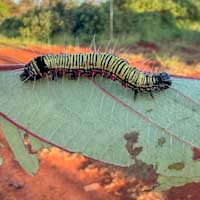
Ramie moth caterpillar feeding on māmaki.
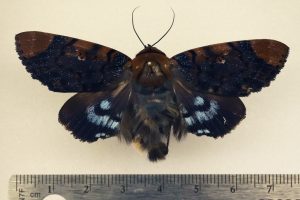
Adult ramie moth image courtesy of CTAHR.

Māmaki is the preferred host for ramie moth caterpillars. Image courtesy of F&K Starr.
Preventing Interisland Spread
Movement of host plants, especially māmaki and other native nettles, poses the highest risk for spreading this pest between islands. While adult moths can disperse locally by flight and may be carried by wind currents, infested plant material remains the primary pathway for long-distance spread.
Because small larvae and eggs can be hidden on leaves and stems, they may go unnoticed during transport.
In Hawaiʻi, most plants and plant materials moving between islands must be inspected by the Hawaiʻi Department of Agriculture (HDOA) Plant Quarantine Branch prior to shipment. These inspections help prevent the movement of insects, plant diseases, and other regulated pests.
If you are planning to move plants between islands:
- Contact the HDOA Plant Quarantine Branch in advance to arrange inspection.
- Do not transport host plants such as māmaki (Pipturus spp.) or ʻolonā (Touchardia latifolia) without proper clearance.
- Purchase plants locally whenever possible.
- If you suspect a plant may be infested, do not move it – report it.
Inspection information and contact details: https://hdoa.hawaii.gov/pi/
There are quarantine protections already in place to address similar risks. For example, the movement of potted plants and soil to Molokaʻi is prohibited under a Hawaiʻi Department of Agriculture and Biosecurity interim rule to prevent the introduction of Coconut Rhinoceros Beetle (CRB) to that island. This interim rule may also help protect Molokaʻi, one of the last ramie moth free islands, from an unintentional ramie moth introduction.