THE TARGET: FOUNTAIN GRASS (CENCHRUS SETACEUS )
FOUNTAIN GRASS (CENCHRUS SETACEUS )
- Hawaii Pacific Weed Risk Assessment: 26- High Risk
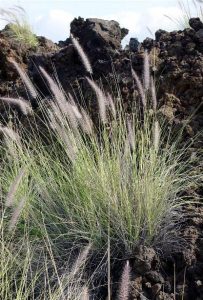
- Fountain Grass (a.k.a Pennisetum setaceum) is listed as a Noxious Weed by the Hawaiʻi Department of Agriculture and one of the top threats to the state. It was first introduced in Hawaii in the early 20th century as an ornamental plant.
- Fountain Grass can form dense monoculture stands. It grows quickly and competes with native species for space, water, and nutrients. It is considered one of the most serious pests in dry areas of Hawaii. As an aggressive colonizer on lava flows this species disrupts primary succession (establishes itself on lava flows first). Fountain Grass: Is fire-adapted and increases the intensity and spread of fires; Damages dry land forest and scrub habitats; Limits shallow water resources to native trees (e.g. Diospyros sandwicensis in Hawaii) in dryland forests; and it has also been shown to replace the native grass Heteropogon contortus in Hawaii. Seeds remain viable yet dormant for at least six years in the soil.
- Distribution:
- Big Island: The big island is the site of the original widespread plantings, over 200,000 acres are infested on the Kona side;
- Oʻahu: Fountain Grass is established and widespread in Lanikai and Diamond Head, and encroaching on the Waiʻanae Mountains;
- Kauaʻi: there is only one known population in sub-optimal habitat above Hanapēpē;
- Lanaʻi and Kahoʻolawe: Several limited populations of Fountain Grass; and
- Maui and Molokaʻi: Known populations have been eradicated.
- What you can do: If you see this species on Kauai, O’ahu, Maui or Molokai please call 643-PEST and/or visit 643pest.org.

THE CANDIDATE: To Be Determined
-
No Biocontrol agent is in development (CABI).
-
The Hawai’i Department of Agriculture (HDOA) states that they have some leads, but more research is needed in Africa (Fountain Grass’ native land) before testing can begin.
Timeline of project progress:
- HDOA states that exploratory trips are being planned to survey for potential Fountain Grass biocontrol agents.
- The Department advises it may be a 10 year timeline to develop and test potential candidates.
Further Information:
- Fountain Grass Profile – Hawaii Invasive Species Council.
- This webpage will be updated as more information is learned.