2026 Hawaiʻi Invasive Species Awareness Month
Together, We Protect Hawaiʻi
ʻAʻohe hana nui ke alu ʻia. No task is too big when done together by all.
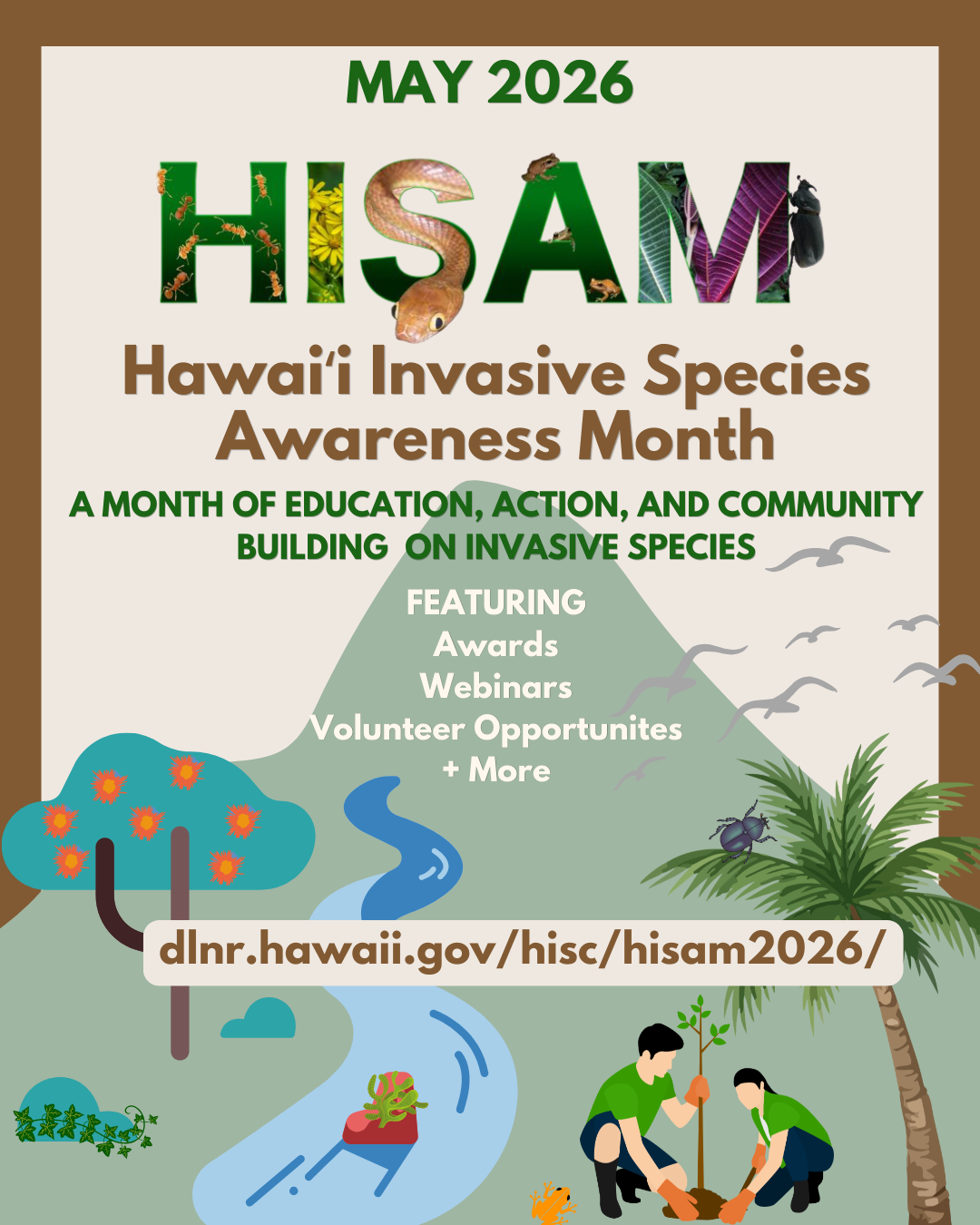
Hawaiʻi Invasive Species Awareness Month celebrates the power of collective action in protecting Hawaiʻi’s ecosystems, agricultural heritage, and communities from the threat of invasive species. This year marks the ninth year of HISAM, building on more than a decade of coordinated outreach and action across the state.
This year’s theme draws from the ʻōlelo noʻeau, ʻAʻohe hana nui ke alu ʻia – no task is too big when done together. This traditional saying reminds us of the power of collaboration. Invasive species can feel overwhelming, but ʻAʻohe hana nui ke alu ʻia– when we work together, even the biggest challenges become possible to overcome. That spirit of working together is rooted in something deeper: huli ka lima i lalo. Turning hands to the land. Across Hawaiʻi, farmers, field crews, community volunteers, kamaʻāina, and conservation professionals are doing exactly that: turning hands to the land.
Invasive species in our own backyards, like coconut rhinoceros beetle, little fire ant, and coqui, can feel overwhelming when faced alone. When communities, agencies, businesses, and partners come together across federal, state, county, and nonprofit lines, we strengthen Hawaiʻi’s ability to prevent, detect, and respond to these threats.
Throughout May, HISAM will feature webinars, events, resources, and awards recognizing the people and partnerships helping to protect Hawaiʻi.
Stay connected throughout HISAM. Sign up for the HISC email list to receive updates on new webinars, events, and the 2026 award announcements. Join the mailing list.
Jump to: Awards • Webinars • Events & Volunteer Opportunities
HISAM AWARDS
Each year, the Hawaiʻi Invasive Species Council recognizes individuals, businesses, and organizations making meaningful contributions to preventing and managing invasive species across the state. Awardees represent the strength of collaboration across communities and partners working together to protect Hawaiʻi.
The 2026 HISAM Awardees are:
- Outstanding Business Leader
Recognizes a business or private-sector leader taking meaningful action to protect Hawaiʻi from invasive species.
2026 Recipient: Alex Redeker / Biosecurity Solutions Hawaiʻi - Community Hero
Recognizes a community member or group demonstrating exceptional dedication to preventing or managing invasive species.
2026 Recipient: Kimeona Kane - Greatest Hit
Recognizes a standout achievement in research, prevention, control, or outreach over the past year.
2026 Recipient: Wendell Vincent & the Hawaiʻi Island HDOT Crew - Island MVP Awardees
Recognizes top contributors from each county.- Oʻahu: Taylor Engle
- Kauaʻi: Serina Marchi & Seascapes Nursery
- Hawaiʻi Island: Ron Aronson
- Maui County: Pūlama Lānaʻi Conservation
Read more about the 2026 HISAM Award recipients
Presentations & Educational Opportunities
Join us throughout May for a series of free webinars and presentations highlighting the people, places, and partnerships working to protect Hawaiʻi from invasive species. Topics include invasive species prevention and response, emerging threats, community-based efforts, and collaborative approaches to conservation across the islands and Moananuiakea (Pacific).
Watch all of this year’s presentations on the HISAM 2026 YouTube Playlist.
Forest Talk: Loulu Bio-Cultural Conservation of Hawaiʻi’s Native Palms 🗓️ May 7, 10:30 AM HST 🎙️ Dr. Tiffany Knight, Dr. Seana Walsh, and Michele Duey (National Tropical Botanical Garden)
Loulu are Hawaiʻi’s only native palms, ecologically vital and culturally foundational for practices such as hale construction and weaving. Today, these iconic species face increasing threats from invasive species, including coconut rhinoceros beetle. Join researchers and conservation practitioners from the National Tropical Botanical Garden for an inside look at biocultural conservation efforts to protect loulu, including work at Lāwaʻi Gardens, home to the world’s largest living collection of these palms. Hosted by Kim Rogers. ▶ Watch on KISC YouTube
Big State, Small Budget: Documenting Idaho Insect Diversity at the Barr Entomological Museum 🗓️ May 12, 9:30 AM HST 🎙️ CTAHR Invasive Species Webinar Series
This webinar highlights how museum collections and digitized specimen data can support insect biodiversity documentation and inform species tracking and identification. 🔗 Information and registration link here
Small Ants, Big Impacts: Managing Invasive Ant Species in North America 🗓️ May 13, 8:00–9:30 AM HST 🎙️ Brooke Mahnken (Maui Invasive Species Committee), Christina Boser (U.S. Fish and Wildlife Service), and Dr. Christopher Hayes (North Carolina State University)
Invasive ants can have major impacts on agriculture, natural areas, wildlife, and communities. This webinar features perspectives from Hawaiʻi and across the continental U.S., including efforts to detect and manage little fire ants on Maui, control Argentine ants in sensitive island ecosystems, and address the emerging threat of Asian needle ants. Presenters will share insights into the biology, spread, and management of these high-priority species, along with practical lessons for early detection and response. Hosted via NAISMA (North American Invasive Species Management Association). 🔗 More Information and Registration link here
Building the Bike as We Ride It: Developing Control Tools for Marine Invasive Species 🗓️ Monday, May 18, 12:00–1:00 PM HST 🎙️ Christy Martin (Program Manager for the Coordinating Group on Alien Pest Species- CGAPS) and Dr. Thierry Work (Project Leader, U.S. Geological Survey National Wildlife Health Center, Honolulu )
Join this webinar to learn about newly detected marine invasive species in Hawaiʻi, the race to develop practical control methods for use in marine ecosystems, and what hot water, a toilet plunger, and toothpaste all have in common. Speakers will share insights into innovative response efforts, field experimentation, and the realities of “building the bike as we ride it” in marine invasive species management. ▶ Watch on HISC YouTube
Nā Koʻe o ka Lepo – Resolving 150 Years of Hawaiʻi’s Worm Invasions 🗓️ May 20, 10:30 AM HST 🎙️ Dr. Kenneth A. Hayes (Senior Conservation Scientist & Specialist in Malacology and Invertebrate Evolution), Dr. Norine W. Yeung (Specialist in Land Snail Taxonomy, Conservation, and Invasion Biology), and Mandilee M.Y. Hill (Conservation Biology and Invertebrate Taxonomy Researcher)
Invasive earthworms and terrestrial flatworms are quietly transforming Hawaiʻi’s ecosystems from the soil up. This webinar explores more than 150 years of documented worm invasions across the Hawaiian Islands, including highly invasive flatworms and “jumping worms” that alter soil chemistry, impact native seedling recruitment, and potentially contribute to broader “invasional meltdown” dynamics in native forests. Dr. Hayesʻ discusses the ongoing efforts to document species distributions, resolve long-standing taxonomic uncertainties using molecular tools, and strengthen ecosystem-level biosecurity frameworks for Hawaiʻi’s watersheds and conservation areas. ▶ Watch on HISC YouTube
What Bees Can Tell Us About Invasive Species: Investigating eDNA in Honey 🗓️ May 20, World Bee Day, Noon HST 🎙️ Jim & Carey Yost (Jim & Carey’s Happy Bees)
Honey bees forage across the landscape collecting tiny traces of biological material from plants, animals, fungi, and pathogens. These traces of environmental DNA (eDNA) become embedded in hive honey and may provide clues about biodiversity, ecosystem health, and even the early presence of invasive species. Join Jim & Carey’s Happy Bees for a fascinating journey through Hawaiʻi Island honey and learn how bees may help us better understand the environments they inhabit. ▶ Watch on HISC YouTube
On the Front Lines: Understanding and Adapting to Introduced Ceratocystis manginecans in Palau 🗓️ May 20, 2:00–3:00 PM HST 🎙️ Jason Johnson (Ebiil Society) and Dr. Kylle Roy (USDA Forest Service Forest Health Protection)
This webinar explores the emergence of Ceratocystis manginecans, a fungal pathogen causing widespread dieback of endemic trees in Palau. Speakers will discuss ongoing efforts to understand the disease, strengthen forest health response capacity, and prepare for emerging biosecurity threats across Pacific island ecosystems. Hosted by the Pacific Regional Invasive Species and Climate Change Management Network (Pacific RISCC). ▶ Watch on YouTube
Rat Lungworm Disease: What You Need to Know to Protect Your ʻOhana 🗓️ May 22, 10:00 AM HST🎙️ Franny Brewer (Big Island Invasive Species Committee), Wendy Baker (Hawaiʻi Academy of Arts & Sciences), and Kelley O’Leary (Hawaiʻi Department of Health)
Learn how rat lungworm disease moves through Hawaiʻi’s environment, practical steps individuals and families can take to reduce risk of exposure, and updated guidance for medical professionals responding to possible cases. Speakers will discuss the parasite life cycle, transmission pathways, prevention strategies, and current public health recommendations for Hawaiʻi communities. ▶ Watch on HISC YouTube
Strengthening Pacific Readiness for Red Imported Fire Ant: Interagency and International Collaboration 🗓️ May 22 2026, 1:00 PM 🎙️ Dr. Mason Russo (Ports of Entry and Monitoring Program Coordinator, Hawaiʻi Invasive Species Council) and Jarrett Lau (Oʻahu Noxious Weed Specialist, Hawaiʻi Department of Agriculture and Biosecurity)
Red Imported Fire Ant (RIFA) poses a major threat to Hawaiʻi and Pacific Island ecosystems, agriculture, infrastructure, and community wellbeing. This HISAM webinar will highlight collaborative efforts underway to strengthen regional preparedness, coordination, and rapid response planning across the Pacific. Speakers will discuss recent planning efforts, lessons learned from Hawaiʻi’s prevention and response work, and ongoing collaboration between partners including HISC, HDAB, CGAPS, and Guam. The webinar will also include guided discussion and audience questions focused on improving biosecurity coordination and preparedness across the Pacific region. The exact webinar time is still being finalized. Please register if interested, all registrants will receive an email update as soon as the webinar time is confirmed. ▶ Watch on HISC YouTube
Mālama Kāhuli: Leveraging Systematics for Biosecurity Stewardship in the Age of Global Molluscan Invaders 🗓️ May 26, 1:00 PM HST 🎙️ Kenneth A. Hayes and Norine W. Yeung.
Hawaiʻi’s native land snails represent one of the world’s most remarkable evolutionary radiations, but invasive gastropods increasingly threaten this biocultural heritage through impacts to agriculture, native forests, and public health. This webinar explores how modern taxonomy, molecular barcoding, and anatomical analysis are critical tools for identifying cryptic invasive species that can bypass traditional biosecurity systems. Drawing on decades of survey work and systematic revisions, the speakers will discuss the importance of proactive field surveys, taxonomic expertise, and strengthened biosecurity infrastructure to better protect Pacific biodiversity. ▶ Watch on HISC YouTube
Vessel Incidental Discharge Act (VIDA) updates and Hawai’i reefs 🗓️ May 27, 1:00 PM HST 🎙️ Andrew Porter (Coordinating Group on Alien Pest Species (CGAPS) legal fellow)
The Vessel Incidental Discharge Act, commonly referred to as VIDA, is federal legislation passed into law on December 4, 2018 that sets national standards for discharges incidental to the normal operation of a vessel, including ballast water, vessel biofouling, and vessel hull in-water cleaning, while also preempting state authority to regulate such discharges. VIDA has resounding implications for states’ ability to set regulations for discharges, monitor and inspect for compliance, and assess fees to fund aquatic biosecurity programs. With VIDA potentially coming into full force and effect by the end of 2026, this presentation takes a look at the development of the EPA and USCG regulations under VIDA, how changes were made in regulations to provide more protection for Hawai´i’s natural resources, and challenges Hawai´i and other coastal states now face in providing safe and effective protection for their harbors and nearshore waters from the introduction of aquatic invasive species. This segment will conclude with a look at potential solutions Hawai´i can explore for continuing to meet the goals set out in the Hawai´i Interagency Biosecurity Plan 2017 to 2027 while working within the confines of developing federal regulation. ▶ Watch on HISC YouTube
Responding to the Queensland Longhorn Beetle Invasion in Hawaiʻi 🗓️ May 28, Noon HST🎙️ Dr. Matt Siderhurst and Dr. Roxana Myers of the USDA-ARS Pacific Basin Agricultural Research Center (PBARC) plus Emma Stierhoff of the University of Hawai’i at Hilo will share on what we’ve learned about the biology and behavior of the QLB in Hawai’i, and on an innovative program using locally found parasitic nematodes to combat the pest in affected trees like ‘ulu and kukui. ▶ Watch on HISC YouTube
Watch all of this year’s presentations on the HISAM 2026 YouTube Playlist.
EVENTS & VOLUNTEER OPPORTUNITIES IN YOUR COMMUNITY
Take action in your community by joining one of these local volunteer efforts.
Please review all safety guidelines and requirements before participating.
| Event | Date & Location | Description |
|---|---|---|
| Civil Cafe: Hawaiʻi vs. Invasive Species | May 15, 2026 • Oʻahu & Online (Civil Beat Newsroom, Honolulu) |
Community discussion on invasive species threats in Hawaiʻi and efforts to protect native ecosystems and food security. Panelists include Christy Martin (CGAPS), Dexter Kishida (HDOT), and Kimeona Kane (Waimānalo Neighborhood Board #32), moderated by Civil Beat reporter Thomas Heaton. Time: 5:30 PM – 7:00 PM (Doors open at 4:30 PM) Format: Hybrid (in-person and online) Admission: Free; registration required Registration & event details |
| Loulu Love Fest | May 16, 2026 • Kauaʻi (Lāwaʻi) | Community event celebrating Hawaiʻi’s native loulu palms and the efforts to protect them. Time: 10:00 AM – 4:00 PM Admission: Free and open to the public Event details |
| Menehune Mayhem Keiki Surf Competition – Visit MISC | May 16, 2026 • Maui (Ho‘okipa Beach Park) | Visit the MISC booth and learn how to protect Maui’s natural resources from invasive species. Time: 10:00 AM – 1:00 PM Admission: Free Event details |
| CRB Materials Distribution Days | Multiple dates in May 2026 • Oʻahu and Kauaʻi | Pick up free coconut rhinoceros beetle (CRB) materials during community distribution days. Oʻahu: May 5 – Mānoa; May 19 – Pearl City; May 21 – Mānoa Kauaʻi: May 16 – Loulu Love Fest Additional dates: To be announced Registration: Required Community interest form |
| Waimānalo Coqui Capture: Beginners’ Nights | May 14 & May 21, 2026 • Oʻahu (Waimānalo) | Help control coqui frogs with OISC and partners. Beginner-friendly volunteer nights held twice monthly. Time: 5:30 PM – 9:00 PM Registration: Required via iVolunteer Sign up |
| FHNP Hōlua Backcountry Service Trip | May 23–25, 2026 • Maui (Haleakalā National Park) | Overnight backcountry service trip supporting invasive species removal, seed collection, and trail work. Level: Moderate (8+ miles) Registration: Required Event details |
| Inflatable Walk-Through CRB “Chuggy” Event | May 28, 2026 • Kauaʻi (Līhuʻe) | Interactive CRB education event featuring a walk-through beetle display and community outreach. Time: 10:00 AM Admission: Free |
| Pūpūkea-Paumalū Volunteer Trip | May 30, 2026 • Oʻahu (Pūpūkea-Paumalū) | Volunteer to survey and remove devil weed (Chromolaena odorata) to prevent its spread. Time: 9:00 AM – 1:00 PM Registration: Required Event details |
| DLNR State Parks Volunteer Days | Various dates in May 2026 • Oʻahu | Join DLNR Division of State Parks for volunteer workdays focused on invasive species removal, native habitat restoration, and mālama ʻāina at sites like Lēʻahi and Kaiwi Coast. View volunteer opportunities |
| Waikōloa Dry Forest Preserve Volunteer Day | Ongoing Saturdays • Hawaiʻi Island | Help restore one of Hawaiʻi’s rare dry forests through native planting, seed collection, and invasive species removal. Volunteer information |
| Homeowners Environmental Expo | May 30, 2026 • Oʻahu (Kāneʻohe Elementary School) | Learn practical ways to reduce your environmental impact at home. Includes free native plants and giveaways. Time: 9:00 AM – 12:00 PM Admission: Free and open to the public |
| Maui AgFest & 4-H Livestock Fair – Visit MISC | May 30, 2026 • Maui (War Memorial Special Events Field) | Visit the MISC booth at this large community event celebrating agriculture and local food systems. Admission: $5 adults; keiki free Event details |
| More Volunteer Opportunities Across Hawaiʻi | Throughout May 2026 • Statewide | Looking for more ways to mālama ʻāina? Explore additional opportunities including coastal cleanups, forest restoration, and community stewardship events across the islands. Year of Coastal Kuleana calendar 808 Cleanups volunteer opportunities |
More events will be added throughout the month.
Don’t miss the learning and hands-on opportunities happening throughout Hawaiʻi Invasive Species Awareness Month. Subscribe to the HISC YouTube channel and explore the HISAM 2026 playlist to watch presentations and webinars throughout the month.