THE TARGET: GUNIEA GRASS (MEGATHYRSUS MAXIMUS VAR. MAXIMUS)
GUINEA GRASS (MEGATHYRSUS MAXIMUS VAR. MAXIMUS)
- Hawaii Pacific Weed Risk Assessment: 17- High Risk
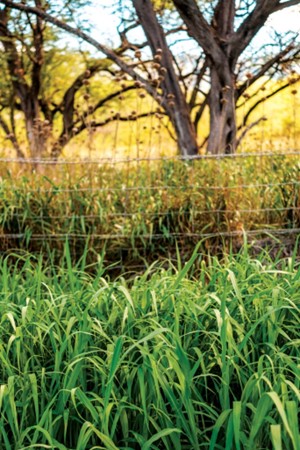
- Guinea Grass is a shade tolerant perennial. It grows in dense bunches, up to nine feet. Its leaves can be up to three feet long by one inch wide. Guinea Grass is capable of producing 9,000 seeds per plant.
- Wild grasses from the African savanna, such as Guinea Grass were widely distributed in Hawai‘i for their forage value.
- Environmental impact:
- Guinea grass is remarkably hardy. While the grass turns pale and lifeless during droughts, it is revitalized after a single rainfall. In heavy rains, long green shoots can sprout overnight.
- Grows into tall dense stands, displaces natives, is a fire hazard in dry periods.
- Can degrade remnant native plant communities, and preclude the establishment and restoration of native species assemblages.
- Flourishes in fallow fields in the absence of grazing animals.
- Highly flammable. A single spark from a campfire or a car’s hot catalytic converter can trigger a massive wildfire, such as the July 2019 blaze in Maui’s central valley that burned 10,000 acres of old sugar cane fields.
- Heavy rains can trigger rapid growth, followed by severe drought, which withers the grass and turns it into tinder substantially raising the fire risk.
- Distribution:
-
Naturalized in Hawai‘i by 1871. Common on all Hawaiian Islands. A serious weed in tropical and subtropical crops and wastelands. Very common in open disturbed areas of forests, wastelands, and roadsides, including in mesic to humid lowlands in Hawai’i.
.
-
- What you can do: If you see this species, call 643-PEST and/or visit 643pest.org.

THE CANDIDATE: To Be Determined
-
More research is needed in Guinea Grass’ native African range to identify herbivores potentially suitable as a biocontrol agent (2009 study).
- The Hawai’i Department of Agriculture (HDOA) states that surveys for potential Guinea Grass biocontrol agents are being planned.
Timeline of project progress:
- HDOA has advised it may be a 10 year timeline to develop and test potential candidates.
Further Information:
- This webpage will be updated as more information is learned.